Wednesday, April 28, 2021

May - June 2021

Ralph Gibson

Museums Administrator


As we look ahead to a summer that promises to be a little brighter than last summer, staff has been busy with reopening procedures and plans for all our museums. When we get to June, only the Bernhard Museum will remain closed. We hope to reopen that museum later in the summer, but there is another possibility floating in the warming wind. Sometime later this spring, perhaps at the May 25th Board of Supervisors meeting, we will request the Board approve the acquisition of the Fruitvale School near Lincoln. The schoolhouse began as a one room schoolhouse in 1888. In 1923, a second room was added.

The Fruitvale Community Hall Incorporation (FCHI), which owns the schoolhouse, lost the one person with the vision and energy to keep that historic site going. In desperation, they reached out to Supervisor Weygandt who then asked the Museums Division to see how it could help. The FCHI wanted their schoolhouse to be part of the Placer County Museums system. After inspections, estimates by Building Maintenance to make repairs and address immediate Americans with Disabilities Act (ADA) issues, we have moved forward with a budget that scares me a little, but upper management has yet to flinch. The schoolhouse will operate as sort of a Museum/Veteran’s Hall hybrid as one of the main sources of revenue is in rentals

But for us, its value is its priceless history. We plan to not only expand the Fruitvale Living History program but explore and develop new educational programs that target grades 8 and above. The historical and educational potential of this site is immense.

I hope all of you have a terrific summer as we finally emerge from this pandemic. And perhaps, as more sites open for the public to explore, we’ll have one more museum in our County system for people to enjoy.


Kasia Woroniecka

Curator of Collections


Powder flasks were an essential accessory used by hunters and soldiers to store gunpowder used with muzzle-loading firearms. Gunpowder was sold in bulk and flasks of different shapes and sizes were used to carry it in the field. It would pour easily when dry, but would cake and fail to burn when damp, making well-sealed powder flasks necessary.

Embossed and fluted copper powder flask with four hanger rings and a leather strap, c. 1860. Donated by Mark Presley of Auburn. PCM Collection, 1964.18.3

Paper cartridges filled with black powder were in use since the 15th century, but they were not patented until 1808. People were forced to carry separate containers of black powder, bullets, and wads. Muzzle-loading a musket required multiple steps, but a well-trained soldier could load and fire two or three times a minute. Generally, a small amount of loose powder was poured into a measure and then down the barrel of the gun. A lead ball was placed on a lubricated patch on the muzzle, and then pushed down the barrel. A small amount of powder was placed on the firing pan, which was located between the cock and the frizzen. The cock was pulled back, the frizzen was closed, and the weapon was ready to fire.

Small copper flask with an embossed eagle with a shield, arrows, and olive branch and a brass spout. Made for the Colt pocket model or similar revolvers. Donated by Arthur Nicholls of Berkeley. PCM Collection, 1969.24.1

Powder flasks were made of different materials, most often copper, silver, wood, bone and leather. Early flasks were plain, but decorated ones with embossed designs or hunting scenes, became very popular. By the 1860s powder flask production was an increasing industrialized process and factories produced flasks for hunters and the military. Some notable companies include The American Flask & Cap Co., Robbins and Lawrence Company of Windsor, Vt., Samuel Colt, James Dixon & Sons G. & J. W. Hawksley or Bartram & Co. A majority of the flasks in our collection are made of copper, leather, and brass. Here are a few examples:
Violin-shaped copper powder flask with embossed design nd four hanger rings. Possibly English, c. 1845-1880. Donated by Guy and Adeline Gilchrist. PCM Collection, 1948.14.7

 
U.S. Military rifleman's powder flask. Embossed with "Public Property" and a small bugle. Purchased at a yard sale in Pilot Hill. These flasks were made around 1825-1830 in England under contract with the United States Army. The "Public Property" mark was added by the Army to prevent soldiers from stealing them. Donated by William Blotti of Foresthill. PCM Collection, 1991.36.1

Detail on a leather shot flask with an embossed hound, c. 1860. PCM Collection, 2010.0.7


Bryanna Ryan

Supervising Curator


Last month, an exciting new collection has been acquired by our Museums division and is slated to become an installation at the Bernhard Museum Complex. It is a forge, anvil, and bellows that came from the Auburn Iron Works building on Lincoln Way. This building is an official California Point of Historical Interest for reportedly being one of, if not the, oldest continually operating blacksmith shops in California. It sits in the area of town known as “East Auburn,” across from the historic train depot where Central Pacific Railroad track was laid in 1865.

East Auburn

Auburn Iron Works 

Beneath the building, runs the South Yuba (formerly, Bear River) ditch – another historically significant feature of Auburn which, no doubt, provided a valuable resource for the blacksmith operations above. Meanwhile, the shift from wagons and railroads to automobiles is another development which impacted this site for more than a century.

We have begun researching the history of the lot in hopes of learning precise details of this new collection. In 1870, the official Map of Auburn identifies the parcel as Lot 1 of Block 19 and, at the time, was owned by J. J. Smith. Research is ongoing but the earliest blacksmiths identified on the site are George E. Allen and Joseph Sandhofer of the partnership “Allen & Sandhofer.”

Placer Herald, June 25, 1898

In 1888, a bill by this company was approved by the Board of Supervisors and they were noted in the Placer Herald for their work which was mainly as wagonmakers and blacksmiths. In 1891, they even had a California patent approved for their design of “vehicle tongue support.” In 1892, they were one of five blacksmith shops in Auburn. Shortly after, Sandhofer sold his interest to his partner and moved from the area and by 1897, “Walker & Duryea’s Blacksmith Shop” was on the site when a fire broke out in the nearby Kenison & Johnson’s Bottling Works which caused heavy losses in the area and to the blacksmith shop. 

Louis (aka L.A.) Duryea had apprenticed with Sandhofer & Allen and enjoyed glowing local reputation as a blacksmith and man of character, when he took over the business which he ran until 1914. In this year, he sold the operation to William M. and Tillie M. Haines.

Duryea occupies another notable position in local history when he was later appointed deputy by Elmer Gum to fill out the term of F.H. “Big Dip” Dependener when the former deputy was killed in an auto accident in 1928. Duryea was then elected Constable in 1930, an office he occupied until his death in 1938. His obituary in the Placer Herald described him as “a quiet mannered man, strictly square and honest.” He was a member of Parlor 59 of the Native Sons of the Golden West who publicly mourned the loss of their brother.

L.A. Duryea, 2nd row, 2nd from the right 

William Haines was elected to the Placer County Board of Supervisors in 1922 and served in this position for 30 years while continuing to manage his blacksmith shop until selling it in 1937 to Dave F. and Don A. Gebhart who officially adopted the name “Auburn Iron Works” in 1939. They sold the operation to Kent Harris and Norma Harris in 1973 and it is Norma Harris we thank for working with us to have the historic collection transferred to our care.
 
Forge at the Auburn Iron Works


Anvil at the Auburn Iron Works 

We also thank Parlor 59 of the Native Sons of the Golden West for physically moving the pieces to the Bernhard Museum where it temporarily sits awaiting a proper installation.

Bellows awaiting installation at the Bernhard Museum Complex

The Bernhard property once held a blacksmith shop on site and it has long been a goal of Bernhard Museum preservationists, to see one return. A forge, anvil, and bellows would have been very useful resources on the farm. With them, equipment repairs and metalsmithing would save valuable time and keep operations running.

Unidentified blacksmith in Auburn

We are grateful for this opportunity to preserve so many historic themes in Auburn’s history and will look forward to sharing it with the public.

Kelsey Monahan

Curator of Archives


In the late 1880s an interesting phenomenon of “literary societies” appeared in Placer County. These groups formed throughout the area including in Penryn, Forest Hill, Ophir, and Newcastle. One of the most celebrated was the Citrus Literary Society, founded north of Auburn.


The Citrus Literary Society, or C.L.S. as it was sometimes known, was formed in November of 1888 in the Rock Creek District. The purpose of the society was to hold social and literary gatherings that included picnics and dances. Entertainment at the picnics included readings, plays, three-legged races, pie eating competitions, and tug of war contests. The dances comprised of supper and dancing with an orchestra providing the music.

Placer Herald, March 9, 1889


Placer Herald, December 6, 1890

In 1889 the C.L.S. built the Citrus Hall, which was used as a venue for the society’s dances and as a community hall.

Rock Creek residents who were instrumental in the C.L.S. included brothers Thomas and John McCarty, F. Dependener, Fred Gates, and the Duryea brothers Lewis and Walter.

Auburn Journal, November 24, 1893

Unfortunately, the last mention that could be found of the C.L.S. was for their annual dance in 1895, although it seems the Citrus Hall was still used in the community. In 1905 Mrs. A.J. Smith bought the hall and renovated it, she later referred to it as the Rock Creek Hall, and she and her son Walter Smith held many dances and suppers there.

Placer Argus, April 24, 1891

Placer Herald, March 9, 1889

No photos of the society’s picnics or Citrus Hall could be found in our collection. If you have or know of a photograph relating to the Citrus Literary Society, we would love to speak with you!
 

April McDonald-Loomis

President, Placer County Historical Society


Normal is right around the corner! Things are starting to open up! We might even be able to have an in-person general dinner meeting in June. We have the Veteran’s Hall which is more than enough room. The question would be how people feel about food; I don’t even know if we could get a caterer. Potluck? Cookies and iced tea? Please email and let me know how you feel: April.pchs@gmail.com . We will try to have a great speaker to celebrate! If we do meet we will also hold the election that we missed.

By the time you read this, we will have four new plaques up on buildings downtown: 805, 823, 835 and 922 Lincoln Way. We are very grateful to E Clampus Vitas who installed them for us. They’re a great bunch! The new plaque for Firehouse # 1 is on its way and hopefully the Hook and Ladder Company can help us with installation.

Installation at 922 Lincoln Way

I hope you have had a chance to look at the new Landmarks of Auburn book, which is full of information. John Knox and I are working on another one, Historical Buildings of Auburn. With so many historic buildings, it will take a while to produce.
 
Looking forward to seeing you all! April McDonald-Loomis
 

Katy Bartosh

Curator of Education


I've had plenty of questions about when our museums will be hosting education programs again. While we created an amazing array of online resources (that I hope will be used into the future!) I am excited to say we're preparing for Living History. 

We expect to welcome students back to the Bernhard Museum by September. Fall 2021 will start at the end of September and go through mid-November. For Spring 2022, we'll open in late February and continue through May.

Anyone want to pan for gold? Hopefully we'll have our Gold Rush students start right after the New Year. 

It's wonderful to see our museums opening but I definitely won't feel like we're back until we have students doing laundry or acting out early Placer pioneers. 

Are you ready to get out of the house? A little time can make a big difference for students in our education programs. Join our group of volunteers today!


Calendar of Events 

If you have any questions about meetings for May or June, please contact the specific historical organization you are interested in. Thank you!


Historical Organizations

Colfax Area Historical Society 
Jay MacIntyre, President
(530) 346-8599 
colfaxhistory.org

Donner Summit Historical Society
Bill Oudegeest
(209) 606-6859
donnersummithistoricalsociety.org

Foresthill Divide Historical Society
Troy Simester
(530) 367-3535
foresthillhistory.org

Fruitvale School Hall Community Association
Mark Fowler

Gold Country Medical History Museum 
Lynn Carpenter
(530) 885-1252

Golden Drift Historical Society 
Sarah Fugate
(530) 389-2121

Historical Advisory Board
Glenn Vineyard
(916) 747-1961

Joss House Museum and Chinese History Center
Larry Finney
(530) 305-9380 

Lincoln Area Archives Museum
Elizabeth Jansen
(916) 645-3800
laamca.org

Loomis Basin Historical Society
Karen Clifford
(916) 663-3871
ppgn.com/loomishistorical.html

Maidu Museum & Historic Site
Kaitlin Kincade
(916) 774-5934
roseville.ca.us/indianmuseum

The Museum of Sierra Ski History and 1960 Winter Olympics
David C. Antonucci 
(775) 722-3502
Sierraskimuseum.com

Native Sons of the Golden West Parlor #59
Dave Allen
(530) 878-2878
dsallen59@sbcglobal.net

Newcastle Portuguese Hall Association
Mario Farinha
(530) 269-2412

North Lake Tahoe Historical Society
Phil Sexton
(530) 583-1762
northtahoemuseums.org

Old Town Auburn Preservation Society
Lynn Carpenter
(530) 885-1252 

Placer County Genealogical Society
Toni Rosasco
(530) 888-8036
pcgenes.com

Placer County Historical Society
April McDonald-Loomis 
(530) 823-2128
placercountyhistoricalsociety.org

Placer County Museums Docent Guild
Fran Hanson
(530) 878-6990 

Rocklin Historical Society
Hank Lohse 
(916) 624-3464
rocklinhistory.org

Roseville Fire Museum
Jim Giblin
(916) 538-1809
rosevillefiremueum@gmail.org

Roseville Historical Society
Denise Fiddyment
(916) 773-3003

Saturday, February 27, 2021

March - April 2021

Ralph Gibson

Museums Administrator

We are still in the grip of the pandemic, but with multiple vaccines out there, hope is on the horizon. As restrictions begin to ease a little, I want to give you a very general road map for when and how our museums and facilities will reopen.

As I write this, Placer County is still in the Purple Level, which keeps indoor museums closed. When we move to the Red Level, our Placer County Museum in the Courthouse will resume normal hours of operation (everyday 10:00 am – 4:00 pm); the Gold Rush Museum will open Fridays thru Sundays from 1:00 pm – 4:00 pm and the DeWitt History Museum will be open the first Wednesday of the month 12:00 pm – 4:00 pm. When Placer County moves into the Orange Level, the hours and possibly days of operation will expand at the Gold Rush and DeWitt History Museums. The Archives and Research Center will be able to reopen to volunteers and the public after the County moves into the Yellow Level AND our staff there have been fully vaccinated against COVID-19. Even then, the Archives will only be open Tuesdays and Fridays from 1:00 pm – 3:00 pm with just two volunteers and one public researcher onsite at any time, so we’ll create a rotating volunteer schedule. The Bernhard Museum may open on a limited basis once we have been in the Yellow Level for several weeks, but not for guided tours. We may open the museum for walk-throughs similar to what we’ve done for the Heritage Trail.

This is just a draft template and more details will come once we get closer to the Yellow Level. The experts predict that things may get closer to normal by the end of summer or early fall once at least 75% of the population has been vaccinated.

Until then, we sincerely hope all of you stay safe and healthy.
 

Kasia Woroniecka

Curator of Collections

I do not sew, but I really appreciate those that have the skills and the patience to deal with bent needles, bunched up thread or seams coming out wavy. Advanced sewing also requires tools that I do not have, like a sewing machine, sewing shears, rotary cutters, seam rippers, or special marking pens and chalk. Pincushions are also helpful, and it is those little, or not so little, objects that piqued my interest.

During the 19th century, women did not often find themselves with nothing to do and many occupied themselves with sewing clothing and needlework that included embroidery, tatting, lace work, sewing of monograms on household linen and making handkerchiefs and pincushions. Industrial Revolution made needlework supplies more affordable and available. Before John Howe invented the first practical machine for manufacturing pins in 1832, pins were made by hand. They were expensive, in high demand and their shaping required 18 separate steps. Early factories produced fewer than 5,000 pins a day, but by 1835 Howe’s machine was able to produce 70,000 in the same amount of time.

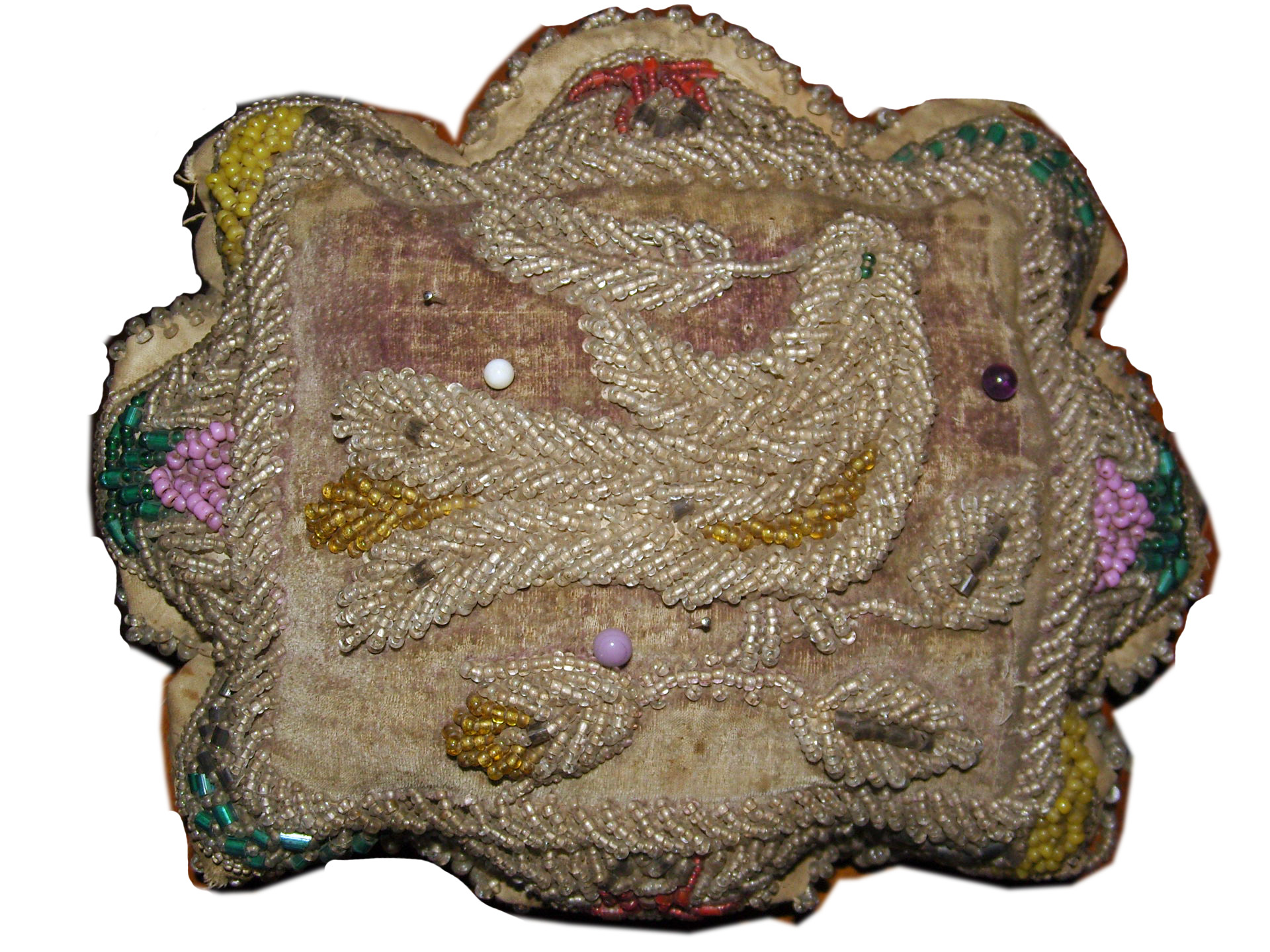
Pincushions came in many designs and were made of different materials. Some were very simple, made of scraps of fabric filled with sand or sawdust. Others were made of velvet, mounted on silver, china or wooden bases, and decorated with glass beads, embroidery, lace and porcelain dolls. They were often stored with other sewing implements in special needle cases or sewing baskets and were a collectable item. Pincushion designs included animals, shoes, fruits and vegetables, like the tomato, which is still popular today. According to Victorian folklore, the tomato was a symbol of prosperity, and when a family moved to a new home a fresh tomato was placed on the mantle for good luck and to ward off evil spirits. Some of the tomato pincushions have a small strawberry attached to it filled with emery powder for cleaning and sharpening pins. Pincushion dolls, with cushions in the shape of skirts, reached the height of their popularity between 1900 and 1930. Most were produced in Germany and France and the early ones were intricately made and very expensive.

Here are a few examples of pincushions in our collection:


Heart-shaped pincushion with a doll. The doll used in decorating this pincushion is part of a Storybook Dolls collection, created by Nancy Ann and made around 1936-1947. Nancy Ann Abbott was born in 1901 as Rowena Haskin. In 1935 she opened a book lending shop where she also sold her dolls. They sold well and in 1936 the Nancy Ann Dressed Dolls Company was born. In 1945 the company became known as the Nancy Ann Storybook Dolls, Inc. During the 1940’s the company was the highest volume maker of dolls in the United States. The company went bankrupt in 1965 after Ms. Abbott’s death in 1964. Donated in 1982 by Ferrel Trimble of Auburn.


Pincushion. Small pillow with lace and three ribbons. Donated in 1987 by the Foresthill Divide Historical Society.


Small pincushion made of cotton fabric with a green flower and leaf pattern. Donated in 1983 by Vincent Gianella of Auburn. Most likely used by his wife, Catherine Gianella, who started sewing at an early. She married Vincent in 1917. He was a professor of geology, who spent his career at the University of Nevada and the Mackey School of Mines. Catherine was active in the Reno Women’s Civic Club, the Reno Twentieth Century Club, and the Women’s Faculty Club of the University of Nevada. In 1957 she was awarded the title of Mother of the Year in Reno by the Nevada Federation of Women’s Clubs. She died in Auburn in 1974.


Pincushion. Red velvet heart with beaded decoration and fringe. Circa 1850. Donated in 1965 by Catherine Sharrer of Carmichael.


Fabric pincushion with a glass stand. Donated in 1996 by Jeanne Whitney of Carmichael.


Pincushion with a beaded design of a bird and flowers. Circa 1950-1870. Found in Collections. On display at the Bernhard Museum in Auburn.


Pincushion with a beaded design of a bird and leaves. Circa 1857. Donated in 1952 by Minnie Shafsky of Berkeley. Minnie was born in 1880 in Auburn. In 1904 she married Louis Shafsky, who opened a dry goods store on Washington Street in Auburn in 1902. On display at the Bernhard Museum in Auburn.


Pincushion with a porcelain half-doll made in Germany circa 1920. The doll is a figure of a Flapper Pierrette, the pantomime character and companion to Pierrot, a sad, lovelorn clown. It was donated in 1977 by the estate of Billie Watkins Olive, a resident of Pilot Hill and avid doll collector.


Pincushion with a porcelain “Lady of the Court” half-doll made in Germany circa 1920. It was donated in 1977 by the estate of Billie Watkins Olive, a resident of Pilot Hill and avid doll collector.

Bryanna Ryan

Supervising Curator

Today, I am excited to announce an update to a project we highlighted way back in the 2019 May/June issue of The Placer. Has it really been two years? Back then, we told you all about our nominations to the California State Library’s California Revealed Project of some really special archival records that were to be digitized and made available to researchers around the globe through Archive.org.


For this nomination, we selected items that would be difficult for us to digitize ourselves and they really needed immediate conservation. They also needed to be very historically significant beyond our local community and be primary sources that could help researchers better understand the past.

We selected eight “Recordiogram” phonograph discs made of vinyl-coated paper that were on loan to us and we had not the ability to properly clean, digitize, or play. We also selected three Chinese manuscripts, the two oldest of which date to 1886 and were from a secretive society known as the Hung Shun Tong. They were extremely fragile, and there was no way to digitized them properly or completely, without disrupting the historic binding.

Recordiograms

Lorraine Anderson

The Recordiogram discs came back to us last year. We had few clues as to what they contained but expected to hear prominent personnel of the DeWitt General Hospital recording their voices in 1944 or 1945. We had chills and a few laughs when we finally listened to their content – a jovial birthday celebration for Lorraine Anderson, the Red Cross Administrator – and heard the voices of people we had only read about.

Here is a link to a fun project Jason and Kelsey did as one of her contributions to last year’s virtual Sacramento-Area Archives Crawl, where you can celebrate Lorraine’s birthday along with the rest of the gang.

https://www.youtube.com/watch?v=FK0I3cu10uY


Just this week, we finally received the digital files for the Chinese manuscripts and I am happy to share them with you. Here is a link where you can find them on Archive.org and learn more about what makes them so special. They have already been shared with scholars from around the world and we hope will become translated and help illuminate the experience of Chinese in northern California around the turn of the 20th Century.

https://archive.org/details/placerresearchandarchives?sort=week&and[]=mediatype%3A%22texts%22

The manuscripts are now being carefully rebound and conserved and soon, will be back in our vault for preservation for generations to come.

To see more of our historic collection, be sure to check out the various artifact highlights Kasia has been creating. You can find them easily on our new online portal at this link.

https://placer.access.preservica.com/artifact-highlights/

Or, if you would like to learn more about the history of Chinese in Placer County, here is a presentation Katy recently prepared on this subject.

https://spark.adobe.com/page/yvWWY7Q7W4gHy

April McDonald-Loomis

President, Placer County Historical Society


Greetings.

It looks like there is some light at the end of the Covid-19 tunnel! Hope you have all been able to get the vaccine or at least have an upcoming appointment. I got my first shot and it is amazing the amount of relief it brings though it will still be a while until things get back to normal. On that note, the board has determined to hold off on the annual election of officers and board members until we can have in-person meetings again. The current board has consented to remain in place.

The Society has another new book out, it will be in several stores and on our website very soon. It is Auburn’s Landmarks, Monuments and Memorials. John Knox spent hours taking photos of plaques and other landmarks around town and we put together a book correcting some old errors and/or adding new information. The second volume of Notable and Interesting Women of Placer County is available as is John Knox’s Auburn Dry Diggings and Water: Rivers, Ravines, Ditches, Springs, Wells and Waste. Get in touch with local history!

April McDonald-Loomis


Katy Bartosh

Curator of Education


You have artifacts, you have a museum or a historic site...but you have a pandemic. How do you connect when you can’t physically bring people and resources together? The last year has been a crash course in trial and error, creativity, and perseverance. And I hope, if anything remains after the pandemic is through with us, that the online content and connections we’ve made, remain.

At Placer County Museums, we now have online resources created specifically for students, primarily 3rd and 4th graders, to help facilitate distance learning. We will also have resources for High School students later this Spring.

Even though the Bernhard Museum Living History program is currently postponed, we have a variety of activity sheets, an online exhibit, and a house tour on YouTube to help students connect. Check out the house tour here, (even if you’re not a third grader!) if you’re missing the Bernhard as much as I am.

For fourth graders, I recently held virtual Gold Rush Programs with over 300 students on Zoom and Google Meets. Most of these schools participate in the program every year, but I also got to work with students in Honolulu! They were able to take advantage of our online worksheets and exhibits on Gold Rush Medicine, the Hidden Treasure Mine, and more...

Whether you’re nine or ninety, these resources are a great way to learn about different aspects of Placer County's history.


Bernhard Museum Living History House Tour: https://www.youtube.com/watch?v=casJ2fuIhOo


Calendar of Events 

If you have any questions about meetings for March and April, please contact the specific historical organization you are interested in. Thank you!


Historical Organizations

Colfax Area Historical Society 
Jay MacIntyre, President
(530) 346-8599 
colfaxhistory.org

Donner Summit Historical Society
Bill Oudegeest
(209) 606-6859
donnersummithistoricalsociety.org

Foresthill Divide Historical Society
Troy Simester
(530) 367-3535
foresthillhistory.org

Fruitvale School Hall Community Association
Mark Fowler

Gold Country Medical History Museum 
Lynn Carpenter
(530) 885-1252

Golden Drift Historical Society 
Sarah Fugate
(530) 389-2121

Historical Advisory Board
Glenn Vineyard
(916) 747-1961

Joss House Museum and Chinese History Center
Larry Finney
(530) 305-9380 

Lincoln Area Archives Museum
Elizabeth Jansen
(916) 645-3800
laamca.org

Loomis Basin Historical Society
Karen Clifford
(916) 663-3871
ppgn.com/loomishistorical.html

Maidu Museum & Historic Site
Kaitlin Kincade
(916) 774-5934
roseville.ca.us/indianmuseum

The Museum of Sierra Ski History and 1960 Winter Olympics
David C. Antonucci 
(775) 722-3502
Sierraskimuseum.com

Native Sons of the Golden West Parlor #59
Dave Allen
(530) 878-2878
dsallen59@sbcglobal.net

Newcastle Portuguese Hall Association
Mario Farinha
(530) 269-2412

North Lake Tahoe Historical Society
Phil Sexton
(530) 583-1762
northtahoemuseums.org

Old Town Auburn Preservation Society
Lynn Carpenter
(530) 885-1252 

Placer County Genealogical Society
Toni Rosasco
(530) 888-8036
pcgenes.com

Placer County Historical Society
April McDonald-Loomis 
(530) 823-2128
placercountyhistoricalsociety.org

Placer County Museums Docent Guild
Fran Hanson
(530) 878-6990 

Rocklin Historical Society
Hank Lohse 
(916) 624-3464
rocklinhistory.org

Roseville Fire Museum
Jim Giblin
(916) 538-1809
rosevillefiremueum@gmail.org

Roseville Historical Society
Denise Fiddyment
(916) 773-3003

Wednesday, December 30, 2020

January - February 2021

Ralph Gibson

Museums Administrator

It’s going to take us a while, perhaps a decade or more, to fully grasp what we experienced in 2020 so I’m not even going to try. As we enter 2021, it’s good to be cautious. The year has ended, not the pandemic. With vaccines, we can see the light at the end of the tunnel and, as long as there aren’t any major setbacks, things should get back to normal this year.

Estimates range from late spring to the end of the year, so, just like in March of 2020, we really have no idea. What we will do is follow expert advice and open our museums and facilities when the state and county permit us to do so with all safeguards in place. Because it will take time to organize a schedule, not all of our museums will reopen at the same time.

The Bernhard Museum will remain closed until the pandemic is effectively over and social distancing and mask wearing are no longer required. Every precaution we take is with the health and safety of the public, our volunteers (most of whom fall into the high-risk category for COVID) and our staff in mind. Perhaps by the next Placer, I’ll feel more confident about predicting when everything will reopen, but until then, stay safe everyone!


Kasia Woroniecka

Curator of Collections

Celebrating messages of love dates back centuries. The advances in printing and the introduction of the postage stamp made the exchange of greeting cards very popular during the Victorian Period. Early Valentine’s Day cards were handmade with paper, lace, ribbons, drawings, and dried flowers. Early cards sold in America were commercially made in England and Germany. In 1848, Esther Howland, an enterprising graduate of a Massachusetts women’s seminary, began manufacturing cards decorated with paper lace and picture collages. Her business thrived and today she is credited with popularizing the American-made Valentine.

These elaborate creations were often displayed in parlors or saved in scrapbooks. They featured cupids, roses, forget-me-nots, four-leaf-clovers, doves, and red hearts. Cupid symbolized desire and was a traditional favorite on valentine’s cards. Roses were associated with strong emotions of love, respect, and courage. Forget-me-nots symbolized true love. Clovers were tokens of luck and affection. Doves represented loyalty, fidelity, and love. The heart, as the symbolic center of all human emotions, meant selfless love.

Placer County Museums has an extensive collection of Valentine’s Day greeting cards and postcards. Among them are a few charming pop-up, or “mechanical” cards that fold out to reveal creative and colorful lithographs, complex die-cut and embossed designs, and three-dimensional foldable honeycomb paper elements. Most of these stand-up cards were printed in Germany around 1900-1920. (Information for each card is located below their photograph.)


Pop-up and die-cut Valentine’s Day card with cupids, doves and forget-me-nots. Printed in Germany c. 1900-1915. 1983.9.95

Donated by Vincent Gianella of Auburn. Vincent Gianella was a professor of geology, who spent his career at the University of Nevada and the Mackey School of Mines. He was a resident of Auburn for twenty years and was a member of the Auburn Rotary Club, the Placer County Historical Society, and the Placer County Historical Museum Foundation.


Pop-up and die-cut Valentine’s Day card with doves and forget-me-nots. Message on back: “To Miss Seal from David.” Circa 1900-1920. 1983.9.96

Donated by Vincent Gianella of Auburn.


Pop-up and die-cut Valentine’s Day card with four-leaf clovers, forget-me-nots and roses. Printed in Germany c. 1900-1915. 1981.34.12

Donated by Ethel Reynolds of Auburn. She was the wife of Walter Reynolds, an Auburn insurance broker. Both were graduates of Placer Union High School.


Pop-up and die-cut Valentine’s Day card with cupid, a honey-comb puff, forget-me-nots and roses. Message on the back: “To my dear grandma from Elroy. February 12, 1916.” 1976.16.67

Donated by Beverly Allyson of Lincoln. Allyson was the manager of Critter Creek Laboratories and Critter Creek Orchards in Lincoln. She was also the president of the Sierra Foothills Dairy Goat Association. 


Pop-up and die-cut Valentine’s Day card with roses and red hearts. “Loving Greetings." Printed in Germany c. 1900-1920. 1976.16.65

Donated by Beverly Allyson of Lincoln.


Pop-up and die-cut Valentine’s Day card with honey-comb puff, four-leaf clovers, forget-me-nots and lilies of the valley. Printed in Germany c. 1900.

Donated by Marion Malcolm of Newcastle. Malcolm was a trustee of the Auburn Union Elementary School board and a member of the Auburn Garden Club. 1994.42.11 


Pop-up and die-cut Valentine’s Day card with cupid, roses and forget-me-nots. Printed in Germany. Message on back: “Love’s greeting to Marion from Whom? Auburn, 1915” 1994.42.9

Donated by Marion Malcolm of Newcastle.


Pop-up and die-cut Valentine’s Day card with a trolley car and cupids. Printed in Germany. Message on back: “From Papa to Marion, 1915.” 1994.42.3

Donated by Marion Malcolm of Newcastle. 

Pop-up and die-cut Valentine’s Day card with forget-me-nots and peach blossoms. Message on back: “Grandfather's and Grandmother's (Hannaman) Valentine to Marion, 1910.” 1994.42.5

Donated by Marion Malcolm of Newcastle.


Pop-up and die-cut Valentine’s Day card with two cupids riding a chariot. Printed in Germany. Message on back: “From Mother, 1911.” 1994.42.1

Donated by Marion Malcolm of Newcastle.


Easel type die-cut Valentine’s Day card with two cupids, a cat and red hearts on a rowboat. Printed in Germany. 1994.42.8

Donated by Marion Malcolm of Newcastle


Pop-up and die-cut Valentine’s Day card with girl, a honeycomb paper puff, and a birdcage. Message on back: “Love’s greeting to Marion from mother, 1914.” 1994.42.2

Donated by Marion Malcolm of Newcastle.


Kelsey Monahan

Curator of Archives

The Rescue of the City of San Francisco

While 2020 was quieter than other years, we did receive some great collections into the Archive and Research Center! One of these great donations was from Placer County Museums docent Laura France, of a scrapbook from her father Clifford France. The scrapbook contains newspaper clippings detailing the four-day saga to rescue 196 passengers and 30 crewmembers from the passenger train City of San Francisco when it was trapped near the Yuba Pass in January of 1952.

On Sunday, January 13, 1952, U.S. Navy Seaman Clifford France was on his way back to his ship in San Francisco from Chicago aboard the City of San Francisco, when snow slides and an ongoing snowstorm stalled the train near the Yuba Pass and buried it in 12 feet of snow. Northern California and the Sierras had been experiencing a series of devastating winter storms that the Auburn Journal declared were the worst since the winter of 1889-1890.

Initially, sprits remained high among the travelers, until it became clear that rescue would not be easy. Because of the ongoing storms and high winds, relief crews using trucks and snowplows struggled to free the train. By Monday, the boilers had run out of water and the train cabins were without heat. In addition to suffering from the cold, some passengers became ill when carbon monoxide fumes entered the cabins from a generator. Luckily, a doctor had been on board on his way to a vacation and was able to help the sick. 


The first relief came Monday night when a group of 13 skiers, aided by a snow tractor, were able to break through the snow and bring food and blankets. The next day, a coast guard helicopter arrived to retrieve ill or injured passengers, but they too were prevented by the storms from reaching them and could only drop off more supplies. It wasn’t until Wednesday, January 16th, that crews were able to clear Highway 40 below the stranded train. Passengers either walked or were taken by snow tractor to waiting cars on the highway. The cars then transported them to the Nyack Lodge in Emigrant Gap, where a rescue train was stationed to finally take them to San Francisco. 


The train itself was not able to be moved until January 19th.

Bryanna Ryan

Supervising Curator

As another year ends, now is a good time for reflection. Time to think back on this past year and place it into the greater story of our lives. 2020 was not just ANY year, either.

Each of our perspectives are colored by a great many things and our experiences – though maybe similar – are not the same.

We hope you will consider sharing your perspectives, reflections, and even life stories with us. There are several ways you can do this, and we would love an opportunity to better document the history of our communities by preserving your experience.

Oral History Interview: If you, or someone you know, would like to participate in an oral life-history interview, let us know! This is a great way to document the unique experience of your life in just a few hours. We are making a list of interviews to conduct for when it is safe to do so in the coming year. Please contact Curator of Archives, Kelsey Monahan, to learn more about the oral history program and how to participate: Kmonahan@placer.ca.gov (530) 889-7789.

Online Survey: Consider taking our “Preserving this Historic Moment” survey. There are several questions designed to better understand how the historic experience of 2020 has played out for you. You may be anonymous if you wish and can take it multiple times as your perspectives may have changed.

Donate Photos: Do you have any photos you would like to donate? There are only two photos in our collection that document the 1918 influenza outbreak in Placer County. Please consider helping us to better document historic 2020 through photos. It is easy to do and you can upload them directly on our collecting portal.


Who knows what the next year will bring but as always, we would love to hear from you! 

April McDonald-Loomis

President, Placer County Historical Society

Here’s hoping the New Year will be a brighter one for all of us! It certainly looks like the vaccine will get us out of these troubling times and I hope everyone will get theirs as soon as it becomes available.

It is still hard to say when we can resume our general dinner meetings with fifty or so people. We will have to wait until we get the go-ahead from the County. We are looking for a particularly dynamic speaker for our first return meeting. If you have any recommendations, do let me know.

Our recent publications, Notable and Interesting Women of Placer County ($5.00) and Auburn Dry Diggings and Water ($20.00) have been selling well. The second volume of Notable Women will be out in January or February. If you haven’t picked up a copy, there is a book order form on the historical society website.

Another book in progress is Auburn’s Landmarks. It should be completed by February. John Knox and I have taken a close look at the landmarks around town to either correct or add information. This will help people understand the reason we have these amazing landmarks. We have certainly learned a lot in the process, and we hope you will too.

We have identified over one hundred plaques and landmarks around Auburn. If you know of one that is fairly obscured or easily missed, please get in contact with me or John. We’ve scoured the area, but you never know. For example, have you ever seen the brass plaque in the middle of Sacramento Street installed to commemorate the making of the movie Phenomenon? It’s an easy one to miss!

Please see the photos below from our latest plaque ceremony for Emily Casement, the Fire Queen, in Old Town Auburn. 


I hope you all continue to stay safe and that it will not be long until we can all get together and celebrate the history of Placer County.


Calendar of Events 

If you have any questions about meetings going into 2021, please contact the specific historical organization you are interested in. Thank you!


Historical Organizations

Colfax Area Historical Society 
Jay MacIntyre, President
(530) 346-8599 
colfaxhistory.org

Donner Summit Historical Society
Bill Oudegeest
(209) 606-6859
donnersummithistoricalsociety.org

Foresthill Divide Historical Society
Troy Simester
(530) 367-3535
foresthillhistory.org

Fruitvale School Hall Community Association
Mark Fowler

Gold Country Medical History Museum 
Lynn Carpenter
(530) 885-1252

Golden Drift Historical Society 
Sarah Fugate
(530) 389-2121

Historical Advisory Board
Glenn Vineyard
(916) 747-1961

Joss House Museum and Chinese History Center
Larry Finney
(530) 305-9380 

Lincoln Area Archives Museum
Elizabeth Jansen
(916) 645-3800
laamca.org

Loomis Basin Historical Society
Karen Clifford
(916) 663-3871
ppgn.com/loomishistorical.html

Maidu Museum & Historic Site
Kaitlin Kincade
(916) 774-5934
roseville.ca.us/indianmuseum

The Museum of Sierra Ski History and 1960 Winter Olympics
David C. Antonucci 
(775) 722-3502
Sierraskimuseum.com

Native Sons of the Golden West Parlor #59
Dave Allen
(530) 878-2878
dsallen59@sbcglobal.net

Newcastle Portuguese Hall Association
Mario Farinha
(530) 269-2412

North Lake Tahoe Historical Society
Phil Sexton
(530) 583-1762
northtahoemuseums.org

Old Town Auburn Preservation Society
Lynn Carpenter
(530) 885-1252 

Placer County Genealogical Society
Toni Rosasco
(530) 888-8036
pcgenes.com

Placer County Historical Society
April McDonald-Loomis 
(530) 823-2128
placercountyhistoricalsociety.org

Placer County Museums Docent Guild
Fran Hanson
(530) 878-6990 

Rocklin Historical Society
Hank Lohse 
(916) 624-3464
rocklinhistory.org

Roseville Fire Museum
Jim Giblin
(916) 538-1809
rosevillefiremueum@gmail.org

Roseville Historical Society
Denise Fiddyment
(916) 773-3003