Saturday, March 2, 2019

March - April 2019

Administrator's Notes

Ralph Gibson, Museums Administrator

This year marks the 150th Anniversary of the Transcontinental Railroad and we’re doing a few things to highlight this significant milestone. The first will be a new exhibit at the Golden Drift Museum in Dutch Flat. The Golden Drift Historical Society contracted with a local Railroad historian and train model enthusiast, Steve Bush, to build a model of the three phases of the Secret Town Trestle near Dutch Flat. Once he’s installed his model, we’ll add other railroad objects and photographs. We’re also expanding the Chinese History exhibit in the same room.
At the Gold Rush Museum we will be installing outdoor interpretive panels that focus on the Transcontinental Railroad and the history of the Auburn Depots. On May 18th at 1:00 pm, Phil Sexton with the California State Parks will give a presentation on the railroad at our Gold Rush Museum.

Another train themed project we’re working on is a small documentary-style film on the Transcontinental Railroad from the perspective of Placer County history. Further, this year’s Heritage Trail will highlight the anniversary with events, exhibits, and programs throughout the county over the summer.

Lastly, it is my sad duty to report the passing of a longtime volunteer for the Placer County Museums, Jerri White Turtle. She was a volunteer for 22 years, working at all three Auburn museums. Lately, Jerri and her husband Sam were regular fixtures at the Old Town Country Christmas events at the Courthouse. Her infectious smile and warm, outgoing personality will be greatly missed.

Everything Old is New Again

Kasia Woroniecka, Curator of Collections

A large collection of awards and trophies was recently transferred to us from the Placer County Treasurer – Tax Collector’s Office. They were awarded to Placer County by the California State Fair and Exposition, the California Agricultural Society, and the Los Angeles County Fair. They date between 1940 -1957. They were awarded to Placer County for excellence, quality, and artistic creativity of exhibits and displays, contributions to agricultural development, and fruit shipping sweepstakes. They are silver-plated and made by Wallace Silver Plate and the International Silver Company, the world’s largest manufacturer of silverware.

The awards were in storage for a long time and all were in need of cleaning and polishing. It was a big project, but the result is a shining example of how a little silver polish can make a huge difference.

Wearing gloves is very important when handling metal objects. Human skin secretes oils and acids that when deposited on metal surfaces cause corrosion and loss of the original surface. Most of our pieces had clearly visible fingerprints before they were cleaned.

Silver objects react with different substances in our environment and become tarnished. Materials
like wood, wool, leather, rubber and newspaper emit gases that cause damage. Before this collection was donated each item was wrapped in newspaper and stored in a cardboard box, which accelerated tarnish. Tarnish in its earliest stages can be cleaned with diluted Dawn dishwashing liquid, as long as it’s citrus free. It can be applied with a cotton ball, a makeup pad or a cotton towel, rinsed and dried immediately. This technique is the safest because it removes no metal, but not very effective on heavily tarnished objects.

There are currently no silver polishes on the market
that are truly non-abrasive and every time the object is cleaned a small part of metal is removed. Some of the least abrasive and widely available silver polishes are made by Blitz or Goddard’s. Examine a piece of silver carefully before cleaning and removing tarnish. Do not allow liquids to enter hollow handles or other places that are difficult to clean and dry. Silver polishing cloths might be most effective in those cases.

To protect the object after cleaning apply a small amount of microcrystalline wax polish. We use Renaissance Wax. It protects objects from water and air-born pollutants and adds an anti-corrosion barrier. Metal objects in regular use, like silver flatware, copper pans or pewter plates should be cleaned as soon as possible after use.


Peeking Under the Hood

Jason Adair, Exhibit Technician

One of the aspects of our new Gold Rush Museum that has received rave reviews are the artifact labels. I thought I’d take a minute and deconstruct how we thought about them; an exhibit case case study, if you will.

It’s no secret that I’m not a fan of extensive labeling. I know how to read but I just don’t like doing it in public because sometimes my lips move. Also, if you watch people read labels as they walk through a museum you’d see that they mostly don’t because every time they start to, they get a text. We also wanted to reframe the artifacts in each case as part of an overall story so that in most cases there is little to no text that is unrelated to something inside. Not only does that make the story we tell with them more interesting and accessible, it also allows us to have less in the way of paragraphs worth of text dumped on passersby or a big “find the artifact that corresponds to this number” chart.

These ideas manifested themselves in different ways throughout the museum but I think they were particularly effective in the Assay Office. This whole case is basically an almost life-sized, non-specific, diorama crammed full with tools of a trade. Our goal was to make the process that would happen in an office like this understandable in a way that would encourage people to search out the items being talked about so they could see first hand how each tool was part of the process.

After researching the process we broke it into six steps that corresponded to the artifacts in the case. I took photos of each piece and then made illustrations of them. (I basically traced over the photos in Adobe Illustrator. A skill I acquired by watching a couple YouTube videos about how to draw with the program tools.)

The hardest part of the whole process was writing the text. The assay process is pretty straightforward, but it’s also very technical. It took a lot of editing and rewriting and rewriting and rewriting to get to the truth of the matter without overcomplicating it to the point of losing comprehension.

Even after the text was approved there were several changes. This had to do with the fact that sometimes (very often) when you’re putting text into a box, or mixing it with graphics, the way the lines break in the space can decrease readability. For example, a line break can derail an entire sentence. When people are casually reading things like labels, all it takes is a bump like that for them to lose focus and walk away toward some other thing on display, or to their phone. Unless they're looking at our displays on their phone. Or reading this article. Do you ever put your phone down?!?


News from the Placer County Historical Society

April McDonald-Loomis, President

Here’s the news from the Board. We are still working on the Old Town Plaque Project. We plan to provide each Old Town business with a large format, cardboard type plaque telling the history of each particular building and/or business that was historically on the site. John Knox and I are doing the research and as always, we are finding new stuff all the time! We will need some additional help when it’s time to have the plaques made. Anyone with any artistic ideas about how the approximately 12’ by 18’ plaques should look? Do let us know.

Thanks to a donation from John and Sharon Blodger we have a new large-scale hanging map in the Benton Welty Schoolroom. It is a real beauty and will be an asset to the classroom tours. We have been busy funding some new projects.
The first is the continuing effort to get all of the Art Sommers Collection of memorabilia to the Placer
An example from the Art Sommers Collection
County Archives. Art made a donation a few years ago, which the Society helped to fund, and he is now ready to part with most of his collection. The Society and the Docent Guild have joined together to make the purchase for $2,000. It is a remarkable collection and a real bargain for us. Art probably doesn’t want to think about how much he has actually spent over the years collecting Placer County items. I have personally seen many single postcards and other ephemera sell for $75.00 or more, and that is just a few examples from the hundreds of items in the collection. We are so fortunate that Art is committed to saving our history. So much would be lost without his efforts over the years.

The second project we are helping to fund is the Chinese Workers Monument. We hope it will be installed in time to commemorate the sesquicentennial of the completion of the transcontinental railroad in May. (By the way, board member Mike Holmes is the only person I know of who can say “sesquicentennial” without stammering or bungling up the pronunciation!) The plan was to put the Monument at the Gold Run rest stop along Interstate 80. That may change though as there seem to be some issues with the State over funding for on-going maintenance. The city of Colfax is also being considered. The Society has contributed $1,000 to this project.

The Society is still looking for one or two people to serve on the Book Committee. This is not a labor-intensive job, just visiting a few shops in town and keeping them supplied with our publications.

We are in the process of changing caterers for our dinner meetings. We desperately need someone to complete the set up and take down at the Veteran’s Hall. This is a paid position and only entails going in early and to take the chairs off the tables, set the tables with cloths, add table decorations (that we already have) and at the end of dinner, to replace the chairs on the tables. No dishwashing involved! Please contact me or Al Stoll for the details.

The Dinner meeting will be April 4th. See our website for more details. Placercountyhistoricalsociety.org. We will have some representatives of the Documented Original Tuskegee Airmen (DOTA) as our speakers. Should be a very interesting evening. Please note that for the first time, we are setting an RSVP deadline. Although we are pleased that folks decide to come at the last moment, the caterer is not so pleased! For the April 4th meeting the RSVP deadline will be March 31st. We will be unable to accept RSVP’s later than that date and will be unable to take folks who just show up at the door. So sorry!


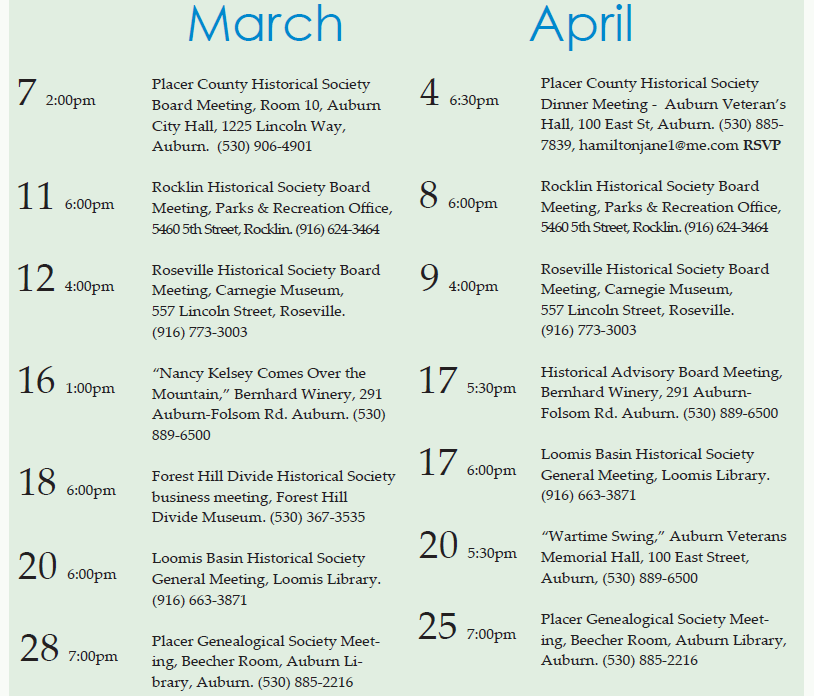
Calendar of Events


Placer County Historical Society Dinner Meeting

When: April 4, 2019
Time: 6:30 Dinner, 7:30 Program
Where: Veterans Memorial Hall, 100 East Street, Auburn
Cost: $16 per person
Menu: TBD
Program: The Speakers will be members of the Documented Original Tuskegee Airmen. They will relate individual stories of the airmen, the history behind the unit, and the story of the DOTA organization.
We must have all RSVPs by March 31st.
Mail Dinner Checks to: PCHS c/o Jane Hamilton, 1871 Crocket Road, Auburn, CA 95603 (530)885-7839 or hamiltonjane1@me.com


Placer County Historical Organizations


Colfax Area Historical Society
Gayle Sorensen (530) 346-8599
colfaxhistory.org

Donner Summit Historical Society
Bill Oudegeest (209) 606-6859
donnersummithistoricalsociety.org

Foresthill Divide Historical Society
Sandy Simester (530) 367-3535
foresthillhistory.org

Fruitvale School Hall Community Association
Lyndell Grey (916) 645-3517

Golden Drift Historical Society
Sarah Fugate (530) 389-2121

Historical Advisory Board
Glenn Vineyard (916) 747-1961

Joss House Museum and Chinese History Center
Richard Yue (530) 346-7121

Lincoln Area Archives Museum
Elizabeth Jansen (916) 645-3800
laamca.org

Lincoln Highway Association
Bob Dieterich  bobd@iname.com
www.lincolnhighwayassoc.org

Loomis Basin Historical Society
Karen Clifford (916) 663-3871
ppgn.com/loomishistorical.html

Maidu Museum & Historic Site
Kaitlin Kincade (916) 782-3299
roseville.ca.us/indianmuseum

The Museum of Sierra Ski History and 1960 Winter Olympics
David C. Antonucci (775) 722-3502
tahoemuseum.org

Native Sons of the Golden West, Parlor #59
Dave Allen (530) 878-2878
dsallen59@sbcglobal.net

Newcastle Portuguese Hall Association
Mario Farinha (530) 269-2412

North Lake Tahoe Historical Society
Marnie Carr (530) 583-1762
northtahoemuseums.org

Old Town Auburn Preservation Society
Lynn Carpenter (530) 885-1252

Placer County Genealogical Society
Toni Rosasco (530) 888-8036
pcgs.pcgenes.com

Placer County Historical Society
April McDonald-Loomis (530) 823-2128
April400@wavecable.com
placercountyhistoricalsociety.org

Placer County Museums Docent Guild
Fran Hanson (530) 878-6990

Rocklin Historical Society
Hank Lohse, President (916) 624-3464
rocklinhistory.org

Roseville Fire Museum
Jim Giblin JGiblin@roseville.ca.us
rosevillefiremuseum.org

Roseville Historical Society
Christina Richter (916) 773-3003
rosevillehistorical.org

Thursday, January 3, 2019

January - February 2019

Administrator's Notes

Ralph Gibson, Museums Administrator

The New Year brings changes to our staff. In December, we selected Curator of Archives, Bryanna Ryan, to be our new Supervising Curator. This means that we’ll soon have a new Curator of Archives and will be back at full strength with seven full time and two part time employees. Although we won’t be building museums, 2019 promises to be a very busy year.

Aside from the Gold Rush and Living History programs and Heritage Trail, two exhibits are on our radar. In the summer, we will install an exhibit commemorating the 60th anniversary of the 1959 Auburn Little League team that made it all the way to the Little League World Series in Williamsport, Pennsylvania. Included in the exhibit will be photographs, loaned artifacts from the players, and the original trophies.

Once that display is installed, work will begin in earnest on our Post Mortem exhibit that will replace the What Killed the American Hat exhibit in the main gallery at the historic Courthouse. This exhibit will probably open in early 2020.


This year we’ll also work to expand the hours of the Gold Rush Museum, edging ever closer to our goal of being open Tuesday-Sunday. We also hope to add a day or two at our DeWitt History Museum. If you know of anyone who might be a good volunteer at one of our museums, please call Bryanna at 530-889-6504. The more volunteers we get, the quicker we can expand the hours at these two great museums.


I wish each of you great 2019!


Old Furniture, New Looks at the Bernhard Museum

Kasia Woroniecka, Curator of Collections

Dressing case.
If you are looking for something new and exciting for the New Year, visit the Bernhard Museum. A recent donation of Victorian furniture offered an opportunity for improvements and inspired some worthwhile exhibit changes. The new pieces reflect the wonderful aspects of Victorian design with their beautiful wood, curvaceous lines and carved detail.

No particular style dominated design during the Victorian period. Rather, it was a revival of various old styles and the mixing of influences from the Middle-East and Asia. Designers drew inspiration from Gothic, Renaissance, Tudor, Rococo and other periods. Frequently a single piece of furniture would incorporate two or more elements of popular styles. The Victorian period coincided with the Industrial Revolution, making it the first era of home furnishings to be manufactured. The use of new materials and construction techniques replaced the traditional craft-apprenticeship system, enabling furniture makers to create new designs and produce them faster and for less money. A large emphasis was placed on mass production, which allowed the middle class to enjoy furniture not previously available to them.


Eastlake inspired marble top table.
Restraint was not part of Victorian interior design. Bare rooms were considered in poor taste, so decoration became a symbol of social class and a way to show off prosperity and status. Patterned wallpapers, dark finishes, embellishments, china, stained glass, lace, carpets, rich fabrics, and accessories were a reflection of good manners and social etiquette that was important to Victorians. 

The furniture pieces in our new collection are examples of the Renaissance Revival style that was very popular in the United States and dates from the late 1850s to the 1890s. Inspired by the 14th century Renaissance period, some of the characteristics of this style include architectural elements, raised or inset panels, carved finials and crests, marble tops, inlays and the often large size of the pieces.

This dressing case has a large mirror that encroaches on the drawer space dividing the top into three parts covered with white marble. Applied veneered walnut panels on the drawers add some drama to the piece.

Eastlake was the new simpler style that was more geometric, with low relief carving and a natural finish. It dates to around 1870-1890. The simple marble top contrasts with the elaborate design of the base, which the Victorians
loved.

Sideboard.
The dining room was the second-most important room in the Victorian house after the parlor and the sideboard was often its focal point. The drawers and
compartments behinds matching doors offered space for flatware, glassware and other pieces needed in the dining room. Above the top of the cabinet is a wooden back supported by shelves, a small mirror and carved ornaments.


Similar to a whatnot, the shelves of the étagère provided space for the displaying porcelain figurines, vases, wax flowers and other collectables typical of Victorian home décor.

From the Archives: Unearthing the Ups and Downs of David Orr

Bryanna Ryan, Supervising Curator

Saloon Tokens
Investigating clues and following promising leads does not always result in a triumph, but that’s what makes a Eureka moment so rewarding.

Two saloon tokens were recently unearthed near Foresthill which prompted an investigation into the history of the Blue Wing Saloon and the David Orr Saloon. When were they built? How long did they operate? Who is David Orr?

Research into the Blue Wing led to a dead-end, for now but the David Orr research was another story and offered much more satisfying results. Using newspaper accounts, probate records, deeds and assessment rolls, a surprising picture began to emerge of David Orr’s ups, downs, and short-lived saloon which existed from 1885-1887.
Deed Book H, Page 476, listing David Orr's property.
Safford & Orr Livery Stable

A well-respected and very early pioneer resident of Placer County, Orr started in mining but ultimately built himself a successful livery and teaming business with animals, barns and stables stationed all along the way from Auburn to Yankee Jims. Teaming was a very dangerous job and in 1859, Orr was held up by two masked highwaymen while carrying express boxes on the route between Bath and Forest Hill. The robbers got away with $1440 in gold dust but not before Orr convinced them to clean up the mess of papers they had dumped on the ground.

In 1870, Orr suffered a serious injury when a mule kicked him in the face and crushed part of his nose and cheek causing permanent disfigurement. However, by far the biggest injury Orr sustained was in 1876 when his team started to panic and run at the top of the hill between Butcher Ranch and Sheridan’s. Before he could pull the brake, Orr was thrown under the wheel of his freight wagon which weighed over 9,000 pounds. The wheel ran over his leg and it had to be amputated immediately.


Yankee Jims, 1857

Forest House, Foresthill

By 1880, perhaps in the interest of changing professions, Orr purchased the Tubbs Saloon in Yankee Jims and it soon becomes known as “David Orr’s Hall” where several dances and parties were hosted until he sold the popular hall in 1885 and finally made his move to Forest Hill. There, he purchased “a certain brick building… situated between the Forest House and Albrechts store on Broadway Street” and this was the same location where the David Orr Saloon burned to the ground in the Forest Hill Conflagration of 1887. It was a total (uninsured) loss of about $8000.

While Orr continued to own and improve upon the lot (and there is a Mrs. David Orr with her own land holdings), he was no longer assessed for any liquor or bar fixtures after the 1887 fire. As the trail continues, David Orr was badly scalded on St. Patrick’s Day in 1894, Mrs. Orr died in 1897, and this “good, peaceable, law-abiding citizen, esteemed by all who know him,” died in 1902.

His legacy only came to light here today because of the small token of the David Orr Saloon that helped to unearth this hidden Placer County legacy.

News From the Placer County Historical Society

April McDonald-Loomis, President

The devastating fire in Paradise brings to mind the most damaging fire in Auburn that historians refer to as “the great fire.” It was June 4th, 1855 when fire swept through the town destroying nearly everything in its wake. At this time, Auburn was only the section we now know as “Old Town.”

Within an hour and twenty-five minutes the fire spread from upper Sacramento Street to the business section of town. About eighty places of business and homes were destroyed. The two big hotels, the Orleans and the Empire, and the offices of the Placer Press and the Placer Herald were gone. Five days after the fire, the first edition of the Placer Herald came out with the help of the employees of both papers at the newly combined headquarters in a blacksmith shop surrounded by horses.
The cost of the destruction was nearly seven million dollars in today’s money.

There were many acts of heroism just like in the Paradise fire. Chesterfield Jackson was rewarded by the County Supervisors for his help in saving the Courthouse. Siffroid Roussin, the local butcher, killed and roasted a whole cow to feed people the night of the fire.


The thing about the Auburn fire, and we can only hope the same will hold true for the Paradise fire victims, is how fast the town rebuilt. Five days after the fire the Herald reported some fifteen buildings were already being rebuilt. By the end of June, twenty-five houses were rebuilt in Chinatown. By the end of the year, Auburn’s rebuilding was almost completed.

The newspaper in May of 1856 reported that “the buildings are better, more convenient and secure and the streets are wider and nearer straight.” Living in Auburn today, you have to love the “nearer straight” comment! Water was now running through pipes all over town and the American Hotel was now three stories and “fire proof brick.” Auburn was thriving, sending out gold dust averaging twenty thousand dollars per week- $640,000 in today’s money.
Placer Herald, April 19, 1879
The townspeople of Paradise will face many more obstacles in rebuilding: wrestling with insurance companies, government bureaucracies, permits and on and on, but hopefully they will rebuild and be even better off -just like Auburn in 1855.
april400wavecable.com  (530) 823-2128

Calendar of Events


Placer County Historical Society Dinner Meeting

When: February 7, 2019
Time: 6:30 Dinner, 7:30 Program
Where: Veterans Memorial Hall, 100 East Street, Auburn
Cost: $16 per person
Menu: Chinese New Year Theme
Program: The Speaker is Stephen Zhou from the US China Railroad Friendship Association who will be talking about the Chinese contribution to the building of the transcontinental railroad over the Sierras.
Mail Dinner Checks to:
PCHS c/o Jane Hamilton, 1871 Crocket Road, Auburn, CA 95603
(530)885-7839 or hamiltonjane1@me.com

Placer County Historical Organizations 

Colfax Area Historical Society
Gayle Sorensen (530) 346-8599

Donner Summit Historical Society
Bill Oudegeest (209) 606-6859

Foresthill Divide Historical Society
Sandy Simester (530) 367-3535

Fruitvale School Hall Community Association
Lyndell Grey (916) 645-3517

Golden Drift Historical Society
Sarah Fugate (530) 389-2121

Historical Advisory Board
Glenn Vineyard (916) 747-1961

Joss House Museum and Chinese History Center
Richard Yue (530) 346-7121

Lincoln Area Archives Museum
Elizabeth Jansen (916) 645-3800
laamca.org


Lincoln Highway Association
Bob Dieterich bobd@iname.com

Loomis Basin Historical Society
Karen Clifford (916) 663-3871

Maidu Museum & Historic Site
Kaitlin Kincade (916) 782-3299

The Museum of Sierra Ski History and 1960 Winter Olympics
David C. Antonucci (775) 722-3502

Native Sons of the Golden West, Parlor #59
Dave Allen (530) 878-2878

Newcastle Portuguese Hall Association
Mario Farinha (530) 269-2412

Newcastle Portuguese Hall Association
Mario Farinha (530) 269-2412

North Lake Tahoe Historical Society
Marnie Carr (530) 583-1762

Old Town Auburn Preservation Society
Lynn Carpenter (530) 885-1252

Placer County Genealogical Society
Toni Rosasco (530) 888-8036

Placer County Historical Society
April McDonald-Loomis (530) 823-2128

Placer County Museums Docent Guild
Fran Hanson (530) 878-6990

Rocklin Historical Society
Hank Lohse, President (916) 624-3464

Roseville Fire Museum
Jim Giblin

Roseville Historical Society
Christina Richter (916) 773-3003

Tuesday, October 30, 2018

November - December 2018


Administrator's Notes

Ralph Gibson, Museums Administrator


The Demons, Ghouls, Witches, and Avengers have all been put away and the stage is being set for the Big Feast, The Big Day and the Big Party. That’s right, the Holidays are around the corner. Each year we interpret the season in different ways at each of our museums. At the Bernhard Museum we have Victorian Christmas where we explore the various holiday traditions of the era. This year we have a special surprise that you’ll have to see for yourself.

At the Griffith Quarry Museum in Penryn we highlight 19th century Welsh Christmas traditions, something Wales-born Griffith Griffith would have been quite familiar with. At the Gold Rush Museum we have excerpts of letters and diaries that highlight what was happening on Christmas Day 1849 in the lives of four miners. At our Placer County Museum in the historic Courthouse we have our grand Christmas Tree beautifully decorated with gold ornaments by our staff and volunteers. We also have a community Christmas tree in the Treasury decorated with paper ornaments made by museum visitors.

This year we will add our DeWitt History Museum to the mix. We have an array of 1940s ornaments and lights and will dress the museum up as a war time Christmas celebration. So please stop by and visit one of our museums to get into the spirit of the holidays this year. The Museums will be fully decorated for the season the Saturday after Thanksgiving. If you’re interested in helping us decorate the tree in the historic Courthouse or the Bernhard Museum, please call Renee at 530-889-6500.

I hope all of you have a wonderful Holiday Season! The holiday season is a busy time for tours.

Collection Strategy

Kasia Woroniecka, Curator of Archives


Flapper Dress

This beautiful beaded and sequined flapper dress was recently donated to our collection. It was made in the 1920s which, according to American Jazz singer Ella Fitzgerald, was a time when “the parties were bigger, the pace was faster, the shows were broader, the buildings were higher, the morals were looser, and the liquor was cheaper.” It was also a time that saw a New Woman emerge who smoked, danced, dated and drank alcohol – she was the Flapper.

Flapper had her origins in the Gibson Girl of the 1890s, who played sports and attended college - activities traditionally reserved for men. Women’s roles were redefined forever by World War I, as they stepped in to fill jobs vacated by men fighting the war in Europe. Their new position gave women financial independence and a strong desire to part with the strict values of their Victorian relatives.

While not every woman was a flapper, by the mid-1920s the short skirt was in style outside the big cities and for women of all ages. To demonstrate their independence in the post-war period, the flappers took off their corsets and shortened their skirts, dropping the waistline to the hips and leaving the arms bare. The newer, simpler silhouette stressed slenderness and mobility, required for the Jazz Age dances like the Charleston and Shimmy.

It became much faster and easier for women to dress fashionably as mass production and the development of affordable synthetic fabrics gave them access to beautiful clothing and shoes. When announcement was first made in 1923 that Mary Brooks Picken of the Woman's Institute had developed a new plan by which an attractive dress could be made in an hour, it aroused tremendous interest among women everywhere. Some doubted that such an achievement was possible, until the dress was made in a public demonstration in the Grand Central Palace, New York, in 34 minutes. The fact was recorded in the New York newspapers and attested to by officials of the National Merchandise Fair.

Even though the happy- go-lucky flapper lifestyle and look did not survive the hardships of the Great Depression it set the tone for the American popular culture and modern American society. Forced with a challenging reality the flapper lifestyle faded amid soup kitchens and bread lines.

From the Archives: Looking for Clues

Bryanna Ryan, Curator of Archives


Many of the photographs that make their way into archives and museums are unidentified. Finding clues to help identify the subjects can be daunting, if not near impossible. 

Photo “orphans” happen when names are not written on photographs or in albums and they are eventually distanced from any last remaining relative who could describe their identity. They end up in yard sales, antique stores, and sadly even the trash.

While orphaned images can still provide valuable insight into clothing, hairstyles, accessories and studio props that were once popular, learning the names and details of the lives of these subjects is what we really hope for. Collaborating with other museums offers one possible avenue for institutions to expand their investigations and attempt to put names to these timeless faces.

Recently, the Folsom History Museum brought us a box of orphaned photograph albums they had been storing since the 1960s in hopes that we might be able to shed some light into their provenance.

Could they be from Placer County? Is there a photograph of the infamous Rattlesnake Dick in them? Wishful thinking on that last part and no, they are too late in time period but that would have been fantastic.

A cursory look into these albums starts to reveal clues we will follow in our investigation. A few names appear and this is where we will start our search. There is also a memorial card for eighteen-year old, Nettie A. Harper who died January 16, 1894. Does this name ring a bell for anyone?

We may never know if this album has a Placer County connection or why Tom O’Keefe sent his photograph to Carrie Stein but we are happy to do our part to help our fellow museums. Who knows, maybe we will find a clue that they have made their way to the right place, after all.

By the way, if anyone has a photograph of Auburn’s historic courthouse under construction we would love to speak with you!


Come to Our Home for the Holidays!

Katy Bartosh, Curator of Education


Out of town relatives visiting, students off school, and time away from work give people free time and the question of how to fill it. Our museums provide the perfect place to spend an afternoon, or two!

Scheduling a tour is an easy process that provides big results for the individuals who get a one-on-one experience. Call the Museum office at 530-889-6500 and ask to schedule a tour. We’ll talk about your interests, where, and when you want to go. If it’s something we can do, we’ll schedule something for your specific needs.

The Bernhard Museum will be decorated for Victorian Christmas in late November. Schedule a tour to learn the home’s unique history and discover the roots of Christmas as we know it today. If you’re more interested in a hands on approach, try the Gold Rush Museum. Visitors will feel like they’ve experienced the history as they’re lead through a variety of interactive exhibits. Miners of all ages will then learn the perfect technique to pan for gold in our indoor stream. Military enthusiasts and Auburn locals alike will enjoy a trip through our newest addition, the DeWitt History Museum, where a wall length aerial photo of the DeWitt Military Hospital immediately draws your attention.

Placer County Museums are perfect for welcoming tours of 30 or a family of three. Call and schedule a tour today. We have a dedicated group of volunteers to help interpret our great selection of exhibits.

News From the Placer County Historical Society

April McDonald-Loomis, President


The Society is currently reviewing the historical plaques that we have previously placed about town with the idea of making sure they are historically correct. Lots of them were placed a long time ago and based on oral tradition instead of on facts. If you know of a plaque that needs to be placed on our list for reconsideration, please let one of the board members know.

The Society will soon have a completely revamped edition of Auburn Images, the book of photographs from the Mel Locher collection. Even if you already have an old edition, you certainly want to get a copy of this new edition. It is filled with updated and new information about scenes from Auburn’s past. The books will be available at the next general meeting in December.

Also in December is the annual end of year raffle. This is always a fun event. So bring some items to raffle off or just come and buy tickets! This is a major fund raiser for the Society.

The city of Auburn has just launched a new website, www.auburn.ca.gov. Check out the great slideshow of town photos put together by Amy Lind, the City Clerk and the City Historian. Go to the website, then to Visitors, then to Auburn History. Hope to see you all at the December 6th general meeting.

april400wavecable.com  (530) 823-2128

Calendar of Events

Click to Enlarge

Placer County Historical Organizations 

Colfax Area Historical Society
Gayle Sorensen (530) 346-8599
colfaxhistory.org

Donner Summit Historical Society
Bill Oudegeest (209) 606-6859
donnersummithistoricalsociety.org

Foresthill Divide Historical Society
Sandy Simester (530) 367-3535
foresthillhistory.org

Fruitvale School Hall Community Association
Lyndell Grey (916) 645-3517

Golden Drift Historical Society
Sarah Fugate (530) 389-2121

Historical Advisory Board
Glenn Vineyard (916) 747-1961

Joss House Museum and Chinese History Center
Richard Yue (530) 346-7121

Lincoln Highway Association
Bob Dieterich bobd@iname.com
lincolnhwy.org

Lincoln Area Archives Museum
Elizabeth Jansen (916) 645-3800
laamca.org

Loomis Basin Historical Society
Karen Clifford (916) 663-3871
ppgn.com/loomishistorical.html

Maidu Museum & Historic Site
Kaitlin Kincade (916) 782-3299
roseville.ca.us/indianmuseum 

The Museum of Sierra Ski History and 1960 Winter Olympics
David C. Antonucci
(775) 722-3502
tahoemuseum.org

Native Sons of the Golden West, Parlor #59
Dave Allen (530) 878-2878
dsallen59@sbcglobal.net 

Newcastle Portuguese Hall Association
Mario Farinha (530) 269-2412

Newcastle Portuguese Hall Association
Mario Farinha (530) 269-2412

North Lake Tahoe Historical Society
Marnie Carr (530) 583-1762
northtahoemuseums.org

Old Town Auburn Preservation Society
Lynn Carpenter (530) 885-1252

Placer County Genealogical Society
Toni Rosasco (530) 888-8036
pcgs.pcgenes.com 

Placer County Historical Society
April McDonald-Loomis (530) 823-2128
April400@wavecable.com 

Placer County Museums Docent Guild
Fran Hanson (530) 878-6990

Rocklin Historical Society
Hank Lohse, President (916) 624-3464
rocklinhistory.org 

Roseville Fire Museum
Jim Giblin
JGiblin@roseville.ca.us
rosevillefiremuseum.org

Roseville Historical Society
Christina Richter (916) 773-3003
rosevillehistorical.org 

Tuesday, August 28, 2018

September - October 2018

Administrator’s Notes 

by Ralph Gibson, Museums Administrator

With the grand opening of the Gold Rush Museum on August 17th and the DeWitt History Museum on February 27th earlier this year, we have completed two huge projects. It was four years ago in 2014 that we learned we would be moving the Gold Country Museum to the Depot and we would be getting a new museum to interpret the history of the DeWitt campus. We essentially took on two capital projects at once with a small staff and relatively small budget. We confronted and overcame obstacles on each front. We endured staff changes and worked around events and programs. In the end, we opened two new museums in the same year! Technically, the Gold Rush Museum celebration was a “re-opening,” but the Gold Rush Museum contains only a few whispers of the museum that languished in the Gold Country Fairgrounds. It truly is a new museum and one that will gain in popularity as word of the opening spreads. Thank you so much to our staff, our Volunteers, the Placer County Museums Docent Guild, the Placer County Historical Society and the Native Sons of the Golden West. We couldn’t have done it without all of you. If you haven’t already, please come by and check out our new museums. They are your museums after all.

Coming up are two Community Education programs. The first is Bill George’s presentation of his film “Beyond a Miracle, Creating California’s Agricultural Empire” on September 15th at 1:00 pm at the Bernhard Winery. The second is the Old Auburn Cemetery Tour at 1:30 pm on October 7th. Look for more details in this newsletter.

Collection Strategy

by Kasia Woroniecka, Curator of Collections

Smoking was popular during the Victorian period, and for many men smoking cigars was a social rite which often involved the wearing of special clothing like a smoking jacket, slippers and even a smoking cap.

Cigars were often sold in bundles wrapped by a silk ribbon with the brand name printed on it. These ribbons were collected and even traded with others to obtain a specific collection and to create various objects like quilts, pillows and tablecloths. These narrow ribbons, which are about ¾ inches wide, were stitched on muslin backing, often with fancy stitching and creative patterns. This small unfinished cigar silk quilt was recently donated to our collection.

Creating these quilts required hundreds of ribbons, so understandably it would have taken a long time and a lot of cigars to create a large quilt. Cigar smoking enjoyed consistent support at the time when cigarettes were still rare. By mid-19th century Americans consumed some 300 million cigars annually; by the end of the century that number surpassed 4 billion. Mark Twin declared that "If I cannot smoke in heaven, then I shall not go."

Since many women discouraged their husbands from smoking tobacco, tobacco companies created clever marketing campaigns that included packaging with silk and felt pieces printed with popular actresses, birds, butterflies, flags and other designs that would appeal to women collectors. Companies encouraged the collecting of ribbons and some even offered ribbons for sale to aid in quilting projects.

Victorian etiquette books agreed that smoking is not a desirable habit, yet it provided quilters with the medium to create something that was necessary in their household. The hallmark of the Victorian Era was change, and even quilters were eager to try something new.

What is this?

Sometimes objects in our collection are a little mysterious. They are mysterious because we don’t know how old they are, who made them or what is their purpose. This object, donated to our collection in 1954, is such an object. It stands on a brass base with two arms and three firmly attached pronged elements, which are not removable.

If you know what this is please e-mail the Curator of Collections Kasia Woroniecka at kworonie@placer.ca.gov.

From the Archives: Boo!

by Bryanna Ryan, Curator of Archives

For those of you who love the eerie, spooky, and haunted side of history, the Old Town Auburn Ghost Tour is back!

Tours will be held at 6pm on Saturday, October 27th; Tuesday, October 30th; and Saturday, November 3rd. This hugely popular event sells out quickly, so I encourage you to get tickets while they last.

In the vicinity of Old Town Auburn is where the killer Adolph Webber made his fateful journeys. Here, there were murders, hangings, and even the town’s original burying ground. The Ghost Tours feature re-enactors and storytellers who will bring this spirited history to life.

If this does not satisfy your thirst for the morbid and macabre, visit the Gold Rush Museum where you can see an authentic noose that was used to carry out capital punishment at the hands of the law.

The Hunt is On! 

by Katy Bartosh, Curator of Education

The Grand Opening for the Gold Rush Museum has passed, and while the exhibits may be completed, it’s time to implement some fun activities. If you’ve been to the Courthouse in the past few months, you may have seen the stand in the lobby with Scavenger Hunts. They may seem simple, but they are a quick and easy tool that can engage visitors from 5 to 55 with your collection.

Now the Gold Rush Museum was lucky to have an Exhibit Technician who could build interactives straight into the Museum itself. But if you don’t have a gold panning stream or a stamp mill, a scavenger hunt may be just the right way to highlight particular objects or broad themes within the museum.

We’ve all seen a visitor walk through a gallery a bit glassy eyed. They’re looking, but not seeing, and having them search for specific artifacts can help them focus. Combine photos and object captions from a few artifacts throughout the gallery on a word document and you’re done. Want something more complicated? You can pick different themes that apply to the time of year, your exhibit, etc. Adding puzzles within the hunt is a good way to entertain children, or create more in-depth activities for events.

Their versatility, and how easy you can change them and print them, also make them a great tool for groups. For example, if a school group is coming to visit with a focus on natural resources, take the template and change all the objects to fit their focus. It works well within the Museum, but can extend to the classroom, special interest groups, holidays, and special exhibitions.

Have fun with it! I certainly do.

They’re Dying to See You  

Murdered and murderers, heartbroken family and lovers, sheriffs and feisty attorneys. All will rise from their graves at the Old Auburn Cemetery on Sunday, October 7, to haunt you with their dramatic stories of Murder and Mayhem in the early days of Auburn’s history.

Sponsored by the Placer County Museums and the Museums’ Docent Guild, this year’s Cemetery Tour will provide visitors with maps to self-guide to 14 gravesites with as many ghostly reenactments.

Located at 170 Fulweiler Avenue, the cemetery will open the tour to the public at 1:30 p.m. and finish at 3:30. Parking will be provided in the County facilities across Fulweiler Avenue from the cemetery. This event is free; no tickets are required.

News from Placer County Historical Society

by April McDonald-Loomis, President


Greetings!

The big news from the Society is the Grand Opening of the Gold Rush Museum this past August 17th. It was pretty hot for the event, but the sterling museum staff were prepared with canopy tents complete with misters, ice cold waters and even cold watermelon. A very nice crowd attended. If you weren’t able to make it, do try to stop by very soon. The museum is outstanding, and the two murals that the Society helped fund are the show pieces! It is amazing the depth and context these murals add to the historical artifacts displays.

Take a look at our website - placercountyhistoricalsociety.org - for some new material. “Friends of Gene Markley,” a group of dedicated folks, have spent an incredible amount of time scanning articles from Gene’s library. There are also some terrific items from vintage Mining and Scientific Press publications that Thomas Birch scanned and are great sources of information. Thanks to Thomas for spending hours and hours to complete this project for us all to be able to access. Thanks are also in store for Jon Brommeland, our webmaster. He keeps us up to date and spends a lot of time ensuring that our website is full of great stuff.

Our next general dinner meeting will be on October 4th. Check the website for details. If you ever have any ideas about speakers you would like to see at our meetings, please contact me or Addah Owens our Vice President and Program Chair. We are always on the lookout for interesting speakers with topics concerning our local history.

Auburn Historic Home Tour 


Sunday, November 4, 2018

10 AM to 4 PM

Here is your chance to see seven local historic homes, some of which have never been open to the public before.

Dr. Snypp’s Queen Ann has been meticulously restored to the late 1800’s and is filled with period antiques.

Attorney Fred Tuttle’s Eastlake home, built in 1890, has been updated inside while keeping the exterior original.

Placer High School Coach Earl Crabbe’s home is a Greene and Greene Craftsman Bungalow built in 1908.

The Trent home, built about 1890, has been extensively remodeled. The property has four rental cottages and a studio apartment in the rear.

Businessman J. M. Francis’ home with Eastlake elements was built about 1898. While some remodeling has been done, it still has the original look.

Superintendent of Schools Irene Burns’ home was built in 1895. The home has been restored and furnished with vintage antiques. This house is listed on the National Register of Historic Places.

Druggist Edward Snowden’s home, built in 1867.

Tickets are $25.00. Proceeds will benefit the State Theater Performing Arts.

They will go on sale September 25th online at www.livefromauburn.com or in person at Eisley Nursery, Wildflower or Lyon Real Estate


Placer County Historical Society Dinner Meeting

by Addah Owens, Vice President

When: October 4
Time: 6:30 Dinner, 7:30 Program
Where: Veterans Memorial Hall, 100 East Street, Auburn
Cost: $16 per person
Menu: Chicken Marsala, mashed potatoes, seasoned vegetables, salad and dessert
Program: Game Changers: Twelve Elections that Transformed California is a thoroughly researched, non-partisan book that dissects how ordinary Californians have sent powerful messages to Sacramento that reverberated under the Capitol dome and beyond. It puts momentous elections in context and analyzes their future impacts on Californians and the state’s political institutions. Co-authors Steve and Susie Swatt will present their findings for the book, which offers thought-provoking interpretation rooted in decades of experience in journalism, public policy analysis, and political consulting at the state Capitol. Steve Swatt is a Sacramento-based political analyst who spent 23 years at KCRA-TV as its political and public policy reporter. Susie Swatt is a member of the National Advisory Council at UC Berkeley’s Institute of Governmental Studies.

DO NOT BRING ALCOHOL.

Mail Dinner Checks to:
PCHS c/o/ Jane Hamilton
1871 Crocket Road, Auburn, CA
95603
(530)885-7839 or hamiltonjane1@me.com

Calendar of Events 

Click to Enlarge

Placer County Historical Organizations 

Colfax Area Historical Society
Gayle Sorensen (530) 346-8599
colfaxhistory.org

Donner Summit Historical Society
Bill Oudegeest (209) 606-6859
donnersummithistoricalsociety.org

Foresthill Divide Historical Society
Sandy Simester (530) 367-3535
foresthillhistory.org

Fruitvale School Hall Community Association
Lyndell Grey (916) 645-3517

Golden Drift Historical Society
Sarah Fugate (530) 389-2121

Historical Advisory Board
Glenn Vineyard (916) 747-1961

Joss House Museum and Chinese History Center
Richard Yue (530) 346-7121

Lincoln Highway Association
Bob Dieterich bobd@iname.com
lincolnhwy.org

Lincoln Area Archives Museum
Elizabeth Jansen (916) 645-3800
laamca.org

Loomis Basin Historical Society
Karen Clifford (916) 663-3871
ppgn.com/loomishistorical.html

Maidu Museum & Historic Site
Kaitlin Kincade (916) 782-3299
roseville.ca.us/indianmuseum 

The Museum of Sierra Ski History and 1960 Winter Olympics
David C. Antonucci
(775) 722-3502
tahoemuseum.org

Native Sons of the Golden West, Parlor #59
Dave Allen (530) 878-2878
dsallen59@sbcglobal.net 

Newcastle Portuguese Hall Association
Mario Farinha (530) 269-2412

Newcastle Portuguese Hall Association
Mario Farinha (530) 269-2412

North Lake Tahoe Historical Society
Marnie Carr (530) 583-1762
northtahoemuseums.org

Old Town Auburn Preservation Society
Lynn Carpenter (530) 885-1252

Placer County Genealogical Society
Toni Rosasco (530) 888-8036
pcgs.pcgenes.com 

Placer County Historical Society
April McDonald-Loomis (530) 823-2128
April400@wavecable.com 

Placer County Museums Docent Guild
Fran Hanson (530) 878-6990

Rocklin Historical Society
Jim Carlson, President (916) 624-3464
rocklinhistory.org 

Roseville Fire Museum
Jim Giblin
JGiblin@roseville.ca.us
rosevillefiremuseum.org

Roseville Historical Society
Christina Richter (916) 773-3003
rosevillehistorical.org