Wednesday, January 1, 2020

January - February 2020

Ralph Gibson

Museums Administrator

I hope everyone had a wonderful Holiday season. 2020 will be another busy year for the museums. This winter our much-expanded Gold Rush Program will begin with nearly 500 registered students for January and February. As soon as that program ends, Spring Living History begins with just over 2400 students signed up to participate.

During it all, we’ll be working on a new exhibit for the Placer County Museum in the historic Courthouse. The working title of the exhibit has been “Postmortem,” but the name we’re leaning toward is “The Good Death”. This exhibit will define what a “Good Death” was and will describe the rituals of death from the Victorian Era to the mid-20th Century. We plan to open in the spring of 2020.

Throughout the summer and Heritage Trail, we’ll be working on another exhibit for the Courthouse: Hawver Cave. Fall Living History begins in September and will run through early November. After that, we’ll decorate for the holidays and manage our Christmas programs. After the attendance at our first S’mores and Stories event at the Bernhard in December, you can expect to see it again this year.

And after that, I’ll be at my computer writing about what is upcoming for 2021. But, for now, I just hope everyone has a terrific 2020!

Kasia Woroniecka

Curator of Collections

Victorian and turn-of-the-20th-century New Year postcards often featured symbols of rebirth, such as butterflies and hatching chicks, and winter imagery like snowmen. The card designs are colorful and playful, yet some of the Victorian visual symbolism they contain might appear rather strange today. Collecting postcards in albums was a popular 19th-century pastime, and we have several albums in our collection. Here are a few examples of New Years postcards:

Placer County Museum Collection, 1910

The snowman is representative of winter and the holidays. Yet in this card he is paired with Pierrot, a lovesick and clumsy character in the French pantomime. Pierrot was a very popular character, used in postcards for different occasions, including Valentines and birthdays.
Placer County Museum Collection, undated

Four-leaf clovers and horseshoes are still used as symbols of good fortune. The leaves in the clover represent faith, hope, love, and luck. Clovers were often featured in Christmas and Near Year postcards to symbolize that the sender is thinking of the recipient.

Placer County Museum Collection, 1906

Pigs were popular as good luck charms in France, England, Ireland, Germany, and Austria during the 19th and early 20th centuries. As the print industry flourished in Europe and the United States, pigs appeared on New Year greetings during the Victorian and Edwardian Period as symbols of good health, happiness, and prosperity - the sentiments associated with Christmas and the New Year.

Placer County Museum Collection, 1906

Christmas and New Year's cards often had scenes of flowers, and birds and their nests as a reminder that spring would be coming.

Placer County Museum Collection, 1907

The forget-me-not signified true love in the Victorian age. It was also a symbol of friendship and was used on cards of all occasions with hope the recipient would not forget the sender.

Placer County Museum Collection, 1906
 
At midnight on New Years’ Eve, bells were rung to symbolize victory over evil and to bring hope for peace and happiness in the year ahead. In the Victorian language of flowers, lily of the valley (bottom left) meant “return of happiness.”

Placer County Museum Collection, 1910
Placer County Museum Collection, 1908
This postcard shows a boy pushing a cart filled with bags full of gold coins. Victorians had many traditions and superstitions associated with the New Year. One of them was the need to have a bit of money in their pockets on New Year’s Day to ward against poverty and misfortune in the new year.

Kissing under the mistletoe was a popular Christmas tradition. The plant is evergreen and in ancient cultures it was used as a symbol of fertility, an antidote for poison, and to ward off evil spirits. During the Victorian Era it was said to bring good luck and lasting friendship.

Wishing you a Happy New Year from the Placer County Museums.

Kelsey Monahan

Curator of Archives


Looking towards the New Year, I have been thinking about how museum collections are always evolving, and our collections are no exception. While new objects come in each year, we also learn more about our existing artifacts thanks to new technology and research conducted by volunteers.

Detroit Safe Company, 1878

Auburn Journal,  May 16, 1929
One example of this is a safe from the Detroit Safe Company. It was donated to the Placer County Museums in 2017 and is on display in the Courthouse hallway. Oftentimes, the only history we have of an artifact is that which the donor can provide. In this case, we knew the safe was manufactured in Detroit, Michigan, July 29, 1878, and had belonged to the Auburn law firm of Lowell, Lowell, and Lowell.


Interior detail
 
However, using new tools we can uncover more information. With access to the archives of the California Digital Newspaper Collection and Newspapers.com, our team can search through historic editions of newspapers for more information.

The front of the safe is painted with the name, “T.E. Stephens.” Thanks to previous research, we know that Thomas E. Stephens started in the grocery business in Auburn in 1862. This building would have been next to the Placer Herald building in what is today Old Town Auburn.

Additional information came up with an article from the Placer Herald in 1878, the same year the safe in the Courthouse was manufactured, which said:

With this information, we can say that it is very likely that the safe in the Courthouse was once in the Stephens store in Auburn. After Stephens passed away in 1892, the store was taken over by G.P. and J.M. Lowell.
 
Interior detail

J.M. Lowell’s sons Marshall Z. Lowell, Arthur C. Lowell, and Orrin J. Lowell would later establish the law firm of Lowell, Lowell and Lowell and practice law in Auburn. In the 1940s a man named John Couzens worked at the firm and when it closed, he purchased the safe from the Lowell estate. He later donated it to the Placer Sierra Bank, and in 2017 it was donated to the museums.

Without the ability to search the historic newspapers, who knows if we would have been able to find the article detailing T.E. Stephen’s purchase of the safe. Thanks to our researchers and the power of technology we can look forward to even more new discoveries about old objects in the new year.

Bryanna Ryan

Supervising Curator

2019 was a year filled with notable commemorations and new beginnings. We celebrated the 1959 Auburn All-Stars and participated in the Gold Country Fair’s 130th anniversary by recreating an 1889 Victorian parlor experience. By fall, we were honoring the completion of the 1869 Transcontinental Railroad with our first mini documentary video. We are grateful for these opportunities to remember the past, the people, and the events that have made a lasting impact in our communities.

In 2020 we are looking forward to more projects. For our next mini documentary video, we are turning our attention toward the DeWitt Complex in North Auburn. What really motivated us with our last mini documentary was the opportunity to illuminate a significant part of Placer County’s history while utilizing the abundance of images and information preserved in the Archive. With the DeWitt video project, we have so much to explore. Extensive research has been gathered and so many fantastic images, objects, and oral histories are available to help bring this story to life.

Picture's from DeWitt's Past
This project will delve into the historic experience of the site, and the role and impact it has had in the local community. From its initial construction beginning in 1943 as the DeWitt General (Army) Hospital, to its role as the DeWitt State “Mental” Hospital, and finally to its current place as the Placer County DeWitt Government Center, this historic site has a fascinating story to tell.

As with all our ambitious projects, we could not accomplish all of this without the generosity, energy, and help of the amazing Museums and Archives volunteers. Thank you for all you do! I am looking forward to seeing what 2020 brings and wish you all a Happy New Year!

April McDonald-Loomis

News from Placer County Historical Society

It’s hard to believe another year has passed. There will be several positions on the PCHS Board opening up in 2020, and we are especially in need of a secretary. If you are interested in serving on the Board, please contact one of the Board members. Speaking of the Board, please see below for our meeting schedule for 2020:

January 2 – Boarding meeting
February 6 – Dinner meeting
March 5 – Board meeting
April 2 – Dinner meeting
May 7 Board meeting
June 4 – Dinner meeting
July 2 – Board meeting
September 3 – Board meeting
October 1 – Dinner meeting
November 5 – Board meeting
December 3 – Dinner meeting

Our December dinner meeting with the raffle was a great success and a lot of fun. The Society was proud to partner with other historical associations to present the very first “Placer County History Award” to journalist Gus Thompson. Gus is keeping the stories and history of the area alive in his many newspaper columns. Take the time to drop an email or a real letter to the editor of the Auburn Journal and tell them how much you enjoy Gus’ columns on local history.

Placer County Historical Society Dinner Meeting
When: February 6th, 2020
Time: 6pm dinner, 6:30pm program
Where: Veterans Memorial Hall, 100 East Street, Auburn
Cost: $16 per person
Menu: TBD
Program: TBD
Mail Dinner Checks to:
PCHS c/o Jane Hamilton, 1871 Crockett Road, Auburn, CA 95603
(530) 885-7839 or hamiltonjane1@me.com
DO NOT BRING ALCOHOL.

Calendar of Events


Historical Organizations

Colfax Area Historical Society
Chris Miller
(530) 346-8599
colfaxhistory.org

Donner Summit Historical Society
Bill Oudegeest
(209) 606-6859
donnersummithistoricalsociety.org

Foresthill Divide Historical Society
Sandy Simester
(530) 367-3535
foresthillhistory.org

Fruitvale School Hall Community Association
Mark Fowler

Golden Drift Historical Society
Sarah Fugate
(530) 389-2121

Historical Advisory Board
Glenn Vineyard
(916) 747-1961

Joss House Museum and Chinese History Center
Richard Yue
(530) 346-7121

Lincoln Area Archives Museum
Elizabeth Jansen
(916) 645-3800
laamca.org

Loomis Basin Historical Society
Karen Clifford
(916) 663-3871
ppgn.com/loomishistorical.html

Maidu Museum & Historic Site
Kaitlin Kincade
(916) 774-5934
roseville.ca.us/indianmuseum

The Museum of Sierra Ski History and 1960 Winter Olympics
David C. Antonucci
(775) 722-3502
tahoemuseum.org

Native Sons of the Golden West Parlor #59
Dave Allen
(530) 878-2878
dsallen59@sbcglobal.net

Newcastle Portuguese Hall Association
Mario Farinha
(530) 269-2412

North Lake Tahoe Historical Society
(530) 583-1762
northtahoemuseums.org

Old Town Auburn Preservation Society
Lynn Carpenter
(530) 885-1252

Placer County Genealogical Society
Toni Rosasco
(530) 888-8036
pcgenes.com

Placer County Historical Society
April McDonald-Loomis
(530) 823-2128
placercountyhistoricalsociety.org

Placer County Museums Docent Guild
Fran Hanson
(530) 878-6990

Rocklin Historical Society
Hank Lohse
(916) 624-3464
rocklinhistory.org

Roseville Fire Museum
Jim Giblin
(916) 538-1809
rosevillefiremueum@gmail.org
rosevillefiremuseum.org

Roseville Historical Society
Denise Fiddyment
(916) 773-3003
rosevillehistorical.org


Saturday, November 2, 2019

November - December 2019

Ralph Gibson

Museums Administrator


It was 170 years ago when tens of thousands of gold hungry men settled into their tents or cabins to experience their first Christmas in the Gold Fields. Yes, there were some who spent their first Christmas here in 1848, but for the 49ers, December 25, 1849 would be their first. At the Gold Rush Museum we give visitors a glimpse into Christmas Day with three journal entries from miners who were either enroute to California, or in Auburn on Christmas Day 1849.

One such account describes a tyrant sea captain aboard a Clipper Ship bound for California with a hull full of would-be miners. Another entry reveals a cold, bleak Christmas Day on the overland journey as a group of emigrants divides their last rations. A third journal entry recounts a humorous encounter with taffy in an Auburn cabin. These reflections of Christmas Day 1849 from three different perspectives reveal the growing significance of the Holiday in American culture. This was most likely due to the popularity of the novel A Christmas Carol by Charles Dickens and the influence of Queen Victoria.
Enlisted men at DeWitt General Hospital, December 1943.
Col. William Smith, Commanding Officer at DeWitt General Hospital with Santa Claus, Commanding Officer of the North Pole, December 1943.

The Holidays are celebrated at our other museums as well. The Bernhard decked out in Victorian Christmas; the grand Christmas Tree in the foyer of the historic Courthouse will sparkle with gold ornaments just outside the gallery of the Placer County Museum; the DeWitt History Museum will give visitors a touch of wartime Christmas spirit; and at the Griffith Quarry Museum visitors can learn some of the Welsh Christmas traditions Griffith Griffith likely brought to Penryn. I hope everyone has a wonderful, warm, merry and happy Holiday Season!

Jason Adair

Exhibits Technician


The Educational Video Series was conceived in a way to get local history research off our shelves and out into the public eye. The Placer County Archives has more than 30,000 local photographs in our care, and a duty to make them available to the public. The museums staff put together a plan for creating a series of ten-minute single subject videos that would highlight different aspects of Placer County’s history.

With a collection as large as ours, including thousands of pages of volunteer authored research, it can be difficult to choose a topic. Fortunately for us the sesquicentennial of the Transcontinental Railroad happened to be this year. Seeing as the railroad runs from one end of Placer County to the other, what better subject could we ask for to create something for all our citizens?

The staff set about the difficult work of figuring out just what story we would tell. What aspects of this infrastructure project were unique to Placer County? Who was the story about? Did it have to be about a person, or people? Was there a way to make the County itself a main character? It was that last question that brought everything into focus.

Making the county a character was a simple enough decision, but it did set up some strange story structure elements. When you’re dealing with an event that was a fight against seemingly insurmountable odds, it naturally begs to be made into a hero’s journey. With that in mind, when you’re pitting man and machine against rugged terrain and the terrain ultimately loses the fight, in some ways it makes the county itself the villain. Maybe not a villain like Darth Vader but definitely like the death star. Is that going to be okay?

That kind of thought process concerning a story may seem ridiculous but if you don’t think in those terms, you run the risk of making a slide show instead of a short film. This is especially true when your video is made of still photos. The audience needs an angle in order to come along on the whole journey.

After sifting through our photo collection and reading hundreds of pages of source materials we began writing. Whenever a group of people from different disciplines with different interests get together to tell a story it has the habit of exploding into eight different stories. This project was no different. Since there is so much in the way of interesting source materials it was difficult to stay focused on the story.

“Have you ever heard of the Placer County Railroad wars that Griffith Griffith was a part of?”

“Stop. Not a part of the story we’re telling. Though we should definitely put a pin in that for a future exhibit or blog post or something because it sounds awesome.”

Another guiding principal in our drafts was, “We’re not a railroad museum.” This was to remind ourselves that we shouldn’t get to deep on any topic of which we weren’t adequately informed. The nuts and bolts of the railroad story was not something we could effectively tell without more research and time. Instead we chose to focus on what we did know, and that’s the geography and history of our county.

After finishing the first draft of the text things began to take shape. Several pages were added, and then pared down, and added more, and pared down again until we had a tight nine-page piece of narration. The final test with voiceover text is to read it out loud. This allows you to see where the tongue twisters and overly long and complex sentences are. Once those were fixed or edited out we were ready to record.

I took a first run at recording the narration myself. My voice was not right but it did give me something to begin editing the video with while we searched for someone else to fit the bill. Fortunately, we had a volunteer docent named Paul Clement who seemed like the perfect candidate. We also have a small recording space in the DeWitt History Museum. This came in handy when I messed up the whole first day of recording by not knowing how to use the program.


A couple days of sitting at a computer pushing buttons and yelling at the screen later and it was done. We uploaded the movie to YouTube and have had nothing but positive feedback. I credit this to the great staff we have working here, our amazing docents and volunteers, the fact that we focused in on our institutional expertise, and because we chose to make the story the most important part.

Watch it today at: Mastering the Mountains on YouTube


Kasia Woroniecka

Curator of Collections


There are several objects in our collection that are not what they appear to be or hold some interesting secrets.


This beautiful Art Deco piece of jewelry looks like a necklace until you turn it over. It has a compartment in the back that holds a pair of folding eyeglasses. Necklace c. 1920-1939, Placer County Museums.

This looks like a uniform button, but it is a locket, manufactured by the Liberty Manufacturing Company of Los Angeles. Known as a “liberty button,” it opens to reveal a place for photos of an unknown woman and a girl. These buttons were indistinguishable from standard issue military buttons allowing a soldier to pass inspection while holding a picture of his loved ones. Button locket c. 1918-1940, Placer County Museums Collection.


This little brooch has a compartment on the back that holds a lock of blond hair. The popularity of hairwork reached its height during the Victorian Period. Hair jewelry was often a mourning accessory, made from the hair of the deceased family member or friend and fashioned into fobs, necklaces, bracelets, earrings, rings and brooches. Hair accessories also served as keepsakes, symbols of friendship or tokens for engaged couples. Mourning pin, Placer County Museums Collection.


Schuco was the trade name for Schreyer & Co, a German toy company founded in 1912 in Nuremburg. In 1924 Schuco introduced a series of miniature bears known as Piccolo Bears. They ranged in size from three to six inches and came in many colors. In 1927 a series of Compact Bears was produced, which was designed to fit in a ladies’ bag and contained a mirror, a compact, a lipstick and either a powder puff, a perfume bottle or a manicure set. This bear has a small compact and what little is left of the lipstick. Schuco teddy bear compact c. 1927, Placer County Museums Collection.


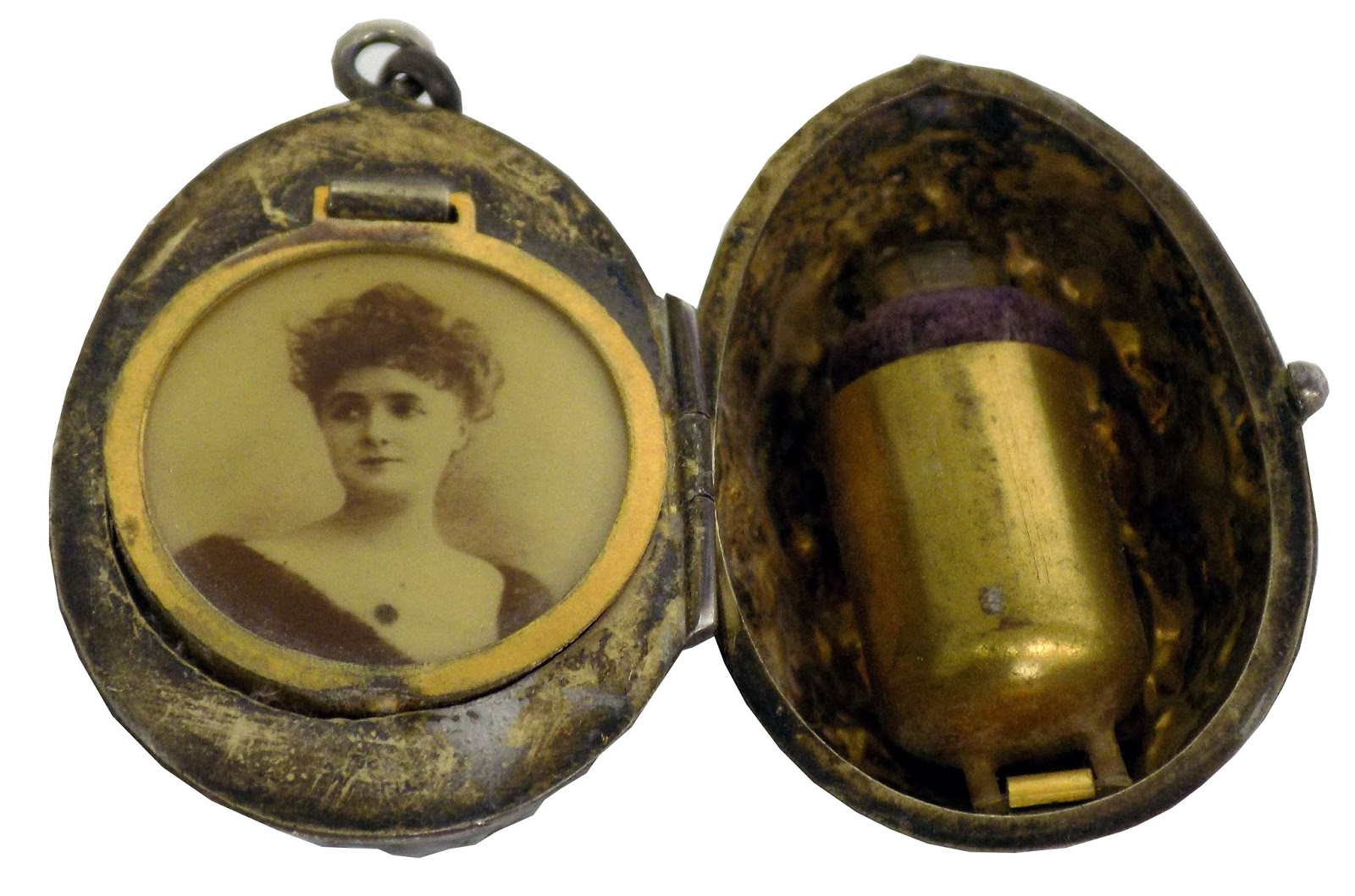
This little silver and brass compact in the shape of a walnut shell opens to reveal a small removable powder puff, a photo of an unknown woman and a small bottle for perfume or smelling salts. Decorative compacts, small vanity cases containing powder, lipstick, mirrors, or more, were fashionable from the early 1900s through the 1960s. Compact c. 1910, Placer County Museums Collection.


April McDonald-Loomis

News from Placer County Historical Society

Karen Bleuel and Sherri Schackner

The plaques for the Old Town businesses are complete and mostly delivered! Karen Bleuel, Sherri Schackner, and Mike Holmes were the board members who set out on “no power” Wednesday to deliver the them. Most of the businesses in Old Town were open and had power, unlike most of us in town.

The overall response was very favorable, and several merchants are planning to frame the plaques. We have a few more to make as some of the addresses now have two storefronts. Thanks to John Knox for being the consummate researcher.

The December dinner is always special. The speaker will be Michael Stark and the topic will be Yankee Jim. Plus, we will have our annual fundraising raffle/drawing. The menu will be prime rib, roasted red potatoes, seasonal vegetable, rolls & butter, and ambrosia. Please RSVP at least a week before to assist our caterer.

Speaking of dinner meetings, it has been suggested that we try using the back room at Sizzler for one of our meetings next year. Please let me know what you think. We would still have a speaker. If you are coming to the dinner, remember to bring something for our annual raffle/drawing.

When: December 5, 2019
Time: 6:00 Dinner, 7:00 Program
Where: Veterans Memorial Hall, 100 East Street, Auburn
Cost: $16 per person
Menu: Prime rib and sides.
Program: The speaker will be Michael Stark on the subject of Yankee Jim. The program will also include the annual fundraising raffle/drawing.
PLEASE RSVP BY Nov. 27th and mail dinner checks to: PCHS c/o Jane Hamilton, 1871 Crockett Road, Auburn, CA 95603. (530) 885-7839 or hamiltonjane1@me.com
DO NOT BRING ALCOHOL.

The Cemetery Tour


The cemetery tour put on by the Docent Guild and museum staff was a huge success and brought in over four hundred people. This is such a fun outing, look for the next one if you missed it this time.
Carol Cramer, organizer, April McDonald-Loomis, researcher, Delana Ruud, greeter.

Joanie Maxwell as Alma Bell.

Pastor Dan as Rattlesnake Dick.

Diane Fishburn as Mrs. Mabel Spear.

Jim Vessely as John Kern.

Heidi Spearer as Carolina Ludwig
 
Bev Call as Minnie Foster.

Christie Brzyscz as Ann Murphy Fogarty.

Calendar of Events


Historical Organizations

Colfax Area Historical Society
Chris Miller
(530) 346-8599
colfaxhistory.org

Donner Summit Historical Society
Bill Oudegeest
(209) 606-6859
donnersummithistoricalsociety.org

Foresthill Divide Historical Society
Sandy Simester
(530) 367-3535
foresthillhistory.org

Fruitvale School Hall Community Association
Lyndell Grey
(916) 645-3517

Golden Drift Historical Society
Sarah Fugate
(530) 389-2121

Historical Advisory Board
Glenn Vineyard
(916) 747-1961

Joss House Museum and Chinese History Center
Richard Yue
(530) 346-7121

Lincoln Area Archives Museum
Elizabeth Jansen
(916) 645-3800
laamca.org

Lincoln Highway Association
Bob Dieterich
bobd@iname.com
lincolnhighwayassoc.org

Loomis Basin Historical Society
Karen Clifford
(916) 663-3871
ppgn.com/loomishistorical.html

Maidu Museum & Historic Site
Kaitlin Kincade
(916) 774-5934
roseville.ca.us/indianmuseum

The Museum of Sierra Ski History and 1960 Winter Olympics
David C. Antonucci
(775) 722-3502
tahoemuseum.org

Native Sons of the Golden West Parlor #59
Dave Allen
(530) 878-2878
dsallen59@sbcglobal.net

Newcastle Portuguese Hall Association
Mario Farinha
(530) 269-2412

North Lake Tahoe Historical Society
(530) 583-1762
northtahoemuseums.org

Old Town Auburn Preservation Society
Lynn Carpenter
(530) 885-1252

Placer County Genealogical Society
Toni Rosasco
(530) 888-8036
pcgenes.com

Placer County Historical Society
April McDonald-Loomis
(530) 823-2128
placercountyhistoricalsociety.org

Placer County Museums Docent Guild
Fran Hanson
(530) 878-6990

Rocklin Historical Society
Hank Lohse
(916) 624-3464
rocklinhistory.org

Roseville Fire Museum
Jim Giblin
(916) 538-1809
rosevillefiremueum@gmail.org
rosevillefiremuseum.org

Roseville Historical Society
Denise Fiddyment
(916) 773-3003
rosevillehistorical.org

Friday, September 6, 2019

September - October 2019

Ralph Gibson

Museums Administrator


As I write this, we are completing the installation of our last exhibit for this year: two displays for the Gold Country Fair.
After that, we’ll take a deep breath, catch up on some things, and start planning our next exhibit: Postmortem. This will replace the “What Killed the American Hat” exhibit in the Courthouse gallery.

Something else we are working on is the Cemetery Tour for October. The Old Auburn Cemetery Tour will be Sunday, October 6th at 1:30 pm. Like last year, a variety of docents and volunteers will be on hand to reenact the colorful lives of past Auburn residents. There is no need to call ahead or purchase tickets. Show up between 1:30-3:30pm at 170 Fulweiler Avenue, and the dead will rise to tell you their stories.

Fall Living History gears up at the end of September and runs through the first week of November and then we’ll start decorating for the Holidays – but that’s another issue. I hope everyone had a great summer and will have a great fall. Happy Halloween!

Kasia Woroniecka

Curator of Collections


Tea became popular in Europe after it arrived from China in the early 1600s. As the demand for exotic beverages like tea, coffee, and chocolate grew, so did the variety and size of the porcelain and silver-plate sets used to serve them. Some of the most elaborate tea services were produced in the Victorian era and could contain more than 40 pieces. The tea kettle and the coffee pot were added to the larger tea services and coincided with the fashion for taking mid-afternoon tea. The tea pots were typically short and round which allowed tea leaves to expand and steep, while coffee pots were tall and slender to retain the heat.

Tea service patterns were often influenced by the neoclassical elements of Greek and Roman art, while the curved forms were informed by the Rococo style. Silver tea sets were popular because they matched the pattern of any porcelain tableware. By the end of the 19th century, many silver service designs were influenced by the simplicity of the Arts and Crafts movement. Teaspoons, sugar spoons, and sugar tongs often accompanied these sets.

Tea is still enjoyed around the world today, with tea sets—old and new—part of the experience.


Haviland & Co. three-piece tea set: tea pot, sugar bowl and creamer. Haviland & Co. started in 1840’s New York as a porcelain importer. In 1842, impressed with the quality of French porcelain, it opened a factory in Limoges and began production for the American market. Haviland & Co. became the chief supplier of porcelain services for the office of the President of the United States, including Presidents Lincoln, Cleveland and Harrison. Placer County Museums Collection

A William Adams silver plated tea and coffee set. This set includes a coffee pot and teapot with black resin handles and knobs along with a kettle stand and burner, a sugar bowl with a lid, and a creamer. Made in Sheffield, England, circa 1902. The town is famous for Sheffield plate, the process of plating copper objects with silver, which made them cheaper than those made of solid silver. Placer County Museums Collection

Porcelain tea set by unknown maker c. 1880-1900. The set includes a tea pot, sugar bowl with lid, a creamer, a candy dish, a set of cups and saucers, and a bowl. The bowl could be a slop bowl, which allowed tea drinkers to pour out the cold tea and leaves left at the bottom of the cup. Slop bowls became standard tea set equipment in the 18th century and came in different shapes and sizes. They were eventually replaced by the tea strainer and seldom appear in modern tea sets. Placer County Museums Collection

Chinese tea set with tea pot, cup and, basket. Circa 1930. Originally tea was valued for its medicinal qualities, aiding digestion and boosting immunity. When tea was introduced to England in 1600s, it was drunk using the traditional handless bowls the Chinese used and referred to as a “dish of tea” rather than a cup. The teacup handles were introduced at the turn of the 19th century. Placer County Museums Collection

Mermod Jaccard quadruple plate four-piece tea set. Mermod Jaccard & Co. was a St. Louis retail jewelry store that also sold silver. The company dates to about 1845. Mermod Jaccard silver was made by various silver manufacturers, but the store marked pieces with its own name. This set includes a tray, teapot, sugar bowl, and creamer. Placer County Museums Collection

Kelsey Monahan

Curator of Archives


Newspapers are one of the most important resources we have at the Archives and Research Center. They contain important information on historical events, vital record information like birth or marriage announcements, and give us insight into what life has been like in Placer County over the years. One of our most frequently researched newspapers, available to the public in our Research Room, is The Placer Herald. The Herald dates to 1852 and was published weekly on Saturday. As you can imagine, some of the volumes are beginning to show their age. Ralph Petri has been volunteering for the Archives since 2014, and he has been hard at work repairing these bound volumes.

Ralph examines each page looking for tears or missing pieces that need to be repaired using a special material called Filmoplast. This acid-free tape is transparent, does not affect the chemistry of the material it is applied to, and it can be removed with water.

Once Ralph has inspected and repaired the pages of an annual volume, he puts them into a book vise, and double sews the pages together. The pages are then given a hinge that is glued with an archival adhesive. Equipped with this hinge the pages and the original covers can be reunited using a new spine cover.

To protect our historic newspapers during this process, all methods and materials are designed for archival purposes and are completely reversible. Once the covers have been attached the volume is ready to be returned to the Research Room for public use.

Repairing the bound volumes of the Placer Herald collection not only makes them easier to access and research but ensures the newspapers will be preserved for future researchers. This project is a perfect example of the important work done by volunteers to make our collection more accessible for researchers, staff, and other volunteers.

Ralph has now repaired almost 70 years of bound volumes! We are so grateful for his work on this project and his book binding expertise.


News from the Placer County Historical Society

April McDonald-Loomis, President


Who doesn’t love Fall in the Foothills? This is probably my favorite time of year, not too hot, not too cold! A few Society projects have been completed.

Part Two of the Art Sommers Collection has arrived and is in capable hands at the Placer County Archives. Art has also decided that there might be a Part Three. If that should happen, we would assist with financing. In the meantime, Art has donated several Placer County related books for the December Society Dinner Meeting.

The research books the Society helped fund for Kasia at the Placer County Collections Facility have arrived and she is delighted with all of them. All the research work has been completed for the plaques for the Old Town businesses. We just need to get them printed and distributed.

Mark your calendar for October 6, 2019 for the Cemetery Tour given by the Museums Docent Guild. This event gets better every year! These terrific individuals, all eighteen of them, will reenact stories of Auburn’s past residents. Beside the regulars like Alma Bell and Rattlesnake Dick, they have several new stories to tell this year. Be on the lookout for poor Katy Andrews, who died way before her time, Hattie Fellows, murdered in her back yard, and many more. These Docents do a fabulous job, making the tour enjoyable for everyone involved. It runs from 1:30 to 3:30 and is free, although like any non-profit, the Guild is always happy to receive donations. It is held at the Old Auburn Cemetery a 170 Fulweiler Avenue.

The Society is involved with other historical organizations in the county that are interested in presenting an annual History Award to an individual who has significantly contributed to Placer County History. If you want to nominate someone, we can provide you with the criteria for the award.

Placer County Historical Society Dinner Meeting

When: October 3, 2019
Time: 6:00 Dinner, 7:00 Program
Where: Veterans Memorial Hall, 100 East Street, Auburn
Cost: $16 per person
Menu: TBD
Program: We are honored to have historian Phil Sexton for our speaker. Phil has been involved with the California State Parks for many years and is considered an expert on many facets of California history. The topic for the presentation will be the Transcontinental Railroad.
PLEASE RSVP BY SEPT. 26th and mail dinner checks to: PCHS c/o Jane Hamilton, 1871 Crockett Road, Auburn, CA 95603. (530) 885-7839 or hamiltonjane1@me.com
DO NOT BRING ALCOHOL.

Come see Placer County Museum's Latest Exhibit, A Season to Remember

on show now at the Historic Courthouse, 101 Maple Street, Auburn, CA


Calendar of Events


Placer County Historical Organizations 


Colfax Area Historical Society
Chris Miller
(530) 346-8599
colfaxhistory.org

Donner Summit Historical Society
Bill Oudegeest
(209) 606-6859
donnersummithistoricalsociety.org

Foresthill Divide Historical Society
Sandy Simester
(530) 367-3535
foresthillhistory.org

Fruitvale School Hall Community Association
Lyndell Grey
(916) 645-3517

Golden Drift Historical Society
Sarah Fugate
(530) 389-2121

Historical Advisory Board
Glenn Vineyard
(916) 747-1961

Joss House Museum and Chinese History Center
Richard Yue
(530) 346-7121

Lincoln Area Archives Museum
Elizabeth Jansen
(916) 645-3800
laamca.org

Lincoln Highway Association
Bob Dieterich
bobd@iname.com
lincolnhighwayassoc.org

Loomis Basin Historical Society
Karen Clifford
(916) 663-3871
ppgn.com/loomishistorical.html

Maidu Museum & Historic Site
Kaitlin Kincade
(916) 774-5934
roseville.ca.us/indianmuseum

The Museum of Sierra Ski History and 1960 Winter Olympics
David C. Antonucci
(775) 722-3502
tahoemuseum.org

Native Sons of the Golden West Parlor #59
Dave Allen
(530) 878-2878
dsallen59@sbcglobal.net

Newcastle Portuguese Hall Association
Mario Farinha
(530) 269-2412

North Lake Tahoe Historical Society
Marnie Carr
(530) 583-1762
northtahoemuseums.org

Old Town Auburn Preservation Society
Lynn Carpenter
(530) 885-1252

Placer County Genealogical Society
Toni Rosasco
(530) 888-8036
pcgenes.com

Placer County Historical Society
April McDonald-Loomis
(530) 823-2128
placercountyhistoricalsociety.org

Placer County Museums Docent Guild
Fran Hanson
(530) 878-6990

Rocklin Historical Society
Hank Lohse
(916) 624-3464
rocklinhistory.org

Roseville Fire Museum
Jim Giblin
(916) 538-1809
rosevillefiremueum@gmail.org
rosevillefiremuseum.org

Roseville Historical Society
Denise Fiddyment
(916) 773-3003
rosevillehistorical.org